
Mobile apps have now turned into a necessary investment for organizations that want toMobile apps are an indispensable tool for any business that aims to develop customer relations and operations and generate more revenues. Irrespective of whether you are creating a startup MVP, eCommerce app, healthcare app, or enterprise application, knowledge of overall mobile development cost will help you plan your budget accordingly.
In 2026, the price of developing a mobile app will vary depending on various factors such as complexity and type of the application, development platform, UI/UX design, backend infrastructure, integrations with other platforms, security issues, testing, and maintenance.
Location from where the development process is conducted is also very important. American companies tend to spend more money on app development due to labor and operational expenses, while most organizations choose to collaborate with highly-experienced development teams from India in order to save budget.
Instead of paying attention to the price of development only, it is necessary to take into consideration the total value of the project and its performance, security, scalability, maintenance, and UX.
How Much Does Mobile App Development Cost in 2026?
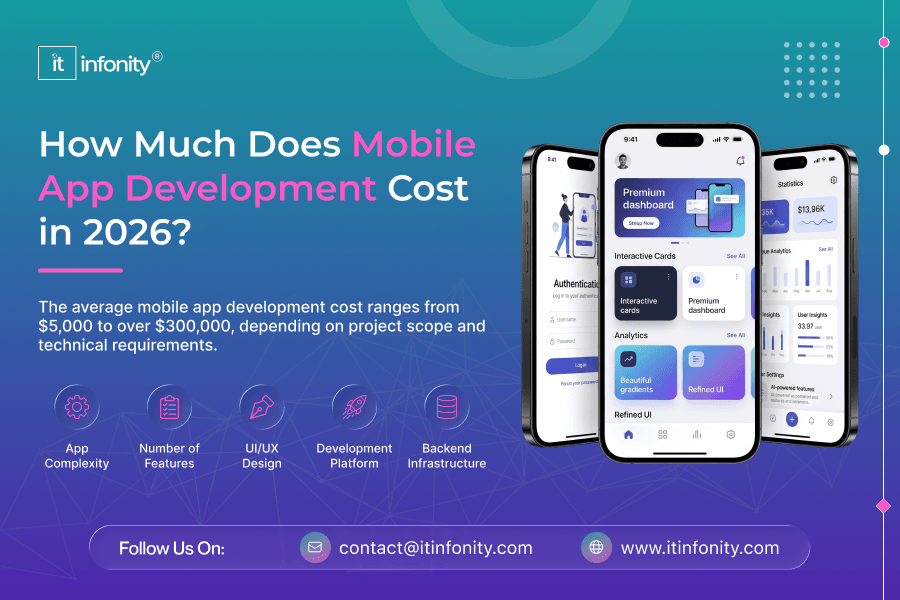
The average mobile app development cost ranges from $5,000 to over $300,000, depending on project scope and technical requirements.
Average Mobile App Development Cost
| App Category | Estimated Cost |
| Basic Mobile App | $5,000–$50,000 |
| Medium Complexity App | $50,000–$120,000 |
| Enterprise Mobile App | $120,000–$300,000+ |
| AI-Powered Mobile App | $100,000–$350,000+ |
Such costs normally cover planning, designing of user interface, front-end development, back-end development, testing, deployment, and project management. Software with high AI functionality, blockchain implementation, IoT features, and enterprise-level security normally cost more.
Mobile App Development Costs by Development Location
Your choice of location for your development team is going to have a big impact on the total cost of your project. Salary costs for developers, operational costs, business rules, and local market conditions affect pricing.
Companies operating in the USA spend more on mobile application development due to higher labor costs and operational costs. However, development companies with a lot of experience from India provide competitive pricing and create scalable, secure, and top-notch applications for international business organizations.
When selecting a development company, you shouldn’t focus only on comparing the price per hour. There are other factors that will help your application succeed in the future.
Average Hourly Mobile App Development Rates
| Development Role | USA | India |
| Junior Developer | $60–$100/hour | $15–$25/hour |
| Mid-Level Developer | $100–$150/hour | $25–$40/hour |
| Senior Developer | $150–$250+/hour | $40–$75/hour |
| UI/UX Designer | $75–$180/hour | $20–$50/hour |
| QA Engineer | $50–$120/hour | $15–$40/hour |
| Project Manager | $80–$180/hour | $25–$60/hour |
Rates vary depending on the developer’s experience, technology stack, project scope, and engagement model.
Average Project Cost by Application Type
| Project Type | USA | India |
| MVP | $30,000–$70,000 | $5,000–$15,000 |
| Startup App | $50,000–$120,000 | $15,000–$40,000 |
| Marketplace App | $80,000–$250,000 | $25,000–$90,000 |
| Healthcare App | $60,000–$200,000 | $20,000–$70,000 |
| AI Mobile App | $100,000–$350,000+ | $35,000–$120,000+ |
| Enterprise App | $150,000–$500,000+ | $40,000–$150,000+ |
These figures are estimates and will depend upon various factors including features needed, industry rules, integration needs, and the overall size of the project.
Expert Insight from IT Infonity
As per our experience in developing custom mobile applications, a good project starts from having a product strategy and not a bunch of features. The discovery process, defined user journey, and the technical planning at an early stage minimize the risk of development and save money.
Mobile App Development Cost by App Complexity
Application complexity is one of the biggest factors affecting development costs. As functionality, integrations, and infrastructure requirements increase, so do development time and investment.
Basic Mobile Apps
Estimated Cost
| USA | India |
| $20,000–$50,000 | $5,000–$15,000 |
Typical Features
- User registration and login
- User profile management
- Contact forms
- Push notifications
- Search functionality
- Basic admin dashboard
Common Examples
- Business apps
- News apps
- Event apps
- Portfolio apps
- Local service apps
Basic applications are ideal for businesses looking to establish a digital presence or launch a simple product with essential functionality.
Medium-Complexity Mobile Apps
Estimated Cost
| USA | India |
| $50,000–$120,000 | $15,000–$40,000 |
Typical Features
- User authentication
- Payment gateway integration
- Booking systems
- Maps and GPS
- Chat functionality
- Push notifications
- Third-party API integrations
- Analytics dashboard
Common Examples
- Food delivery apps
- Fitness applications
- Healthcare booking platforms
- Travel applications
- E-learning apps
These applications require stronger backend architecture, more extensive testing, and integration with external services, increasing both development time and overall cost.
Enterprise & AI-Powered Mobile Apps
Estimated Cost
| USA | India |
| $120,000–$300,000+ | $40,000–$150,000+ |
Typical Features
- Artificial intelligence and machine learning
- Video conferencing
- Real-time synchronization
- IoT integration
- Enterprise-grade security
- Cloud-native infrastructure
- Advanced analytics
- Multi-language support
- Large-scale databases
Common Examples
- Banking applications
- Enterprise SaaS platforms
- Healthcare management systems
- Logistics and supply chain platforms
- AI-powered business solutions
To build enterprise software solutions, you need experienced architects, expert developers, thorough testing and infrastructure.
Why Starting with an MVP Can Reduce Development Costs
The use of MVP when launching a product helps businesses validate their idea by having some necessary features of the app rather than going all the way with the full development.
Using MVP cuts down initial development costs and also helps in receiving valuable feedback from users. This helps in knowing which features to develop later in the product. It also helps in validating the market demand for the app.
This strategy is highly popular among new businesses and even established ones due to its benefits.
Mobile App Development Cost by Platform
The development platform chosen will have a direct effect on development time, cost, maintenance, and scalability. It is important for a business to choose its development platform taking into account the audience that it intends to cater to.
Android App Development Cost
Android is the most commonly used mobile operating system and hence becomes an obvious choice for a business aiming at targeting as broad an audience as possible. However, application optimization across multiple devices will become necessary.
Estimated Cost
| Location | Cost |
| USA | $25,000–$150,000+ |
| India | $8,000–$60,000+ |
Typical development timeline: 3–8 months
iOS App Development Cost
OS applications are commonly chosen by businesses targeting premium users and markets with high iPhone adoption, including the United States.
Estimated Cost
| Location | Cost |
| USA | $30,000–$180,000+ |
| India | $10,000–$70,000+ |
Development Time Frame: 3-8 Months
Cross-Platform App Development Cost (Flutter & React Native)
By using cross platform application development framework, developers can create Android as well as iOS apps in one go.
Estimated Cost
| Location | Cost |
| USA | $25,000–$140,000+ |
| India | $8,000–$55,000+ |
Cross-platform development is often suitable for startups and businesses looking to launch on multiple platforms with a controlled budget.
Mobile App Development Cost Breakdown
Understanding where your budget is allocated helps improve project planning and prevents unexpected expenses.
| Development Phase | Percentage of Total Budget |
| Discovery & Planning | 5–10% |
| UI/UX Design | 10–15% |
| Frontend Development | 25–35% |
| Backend Development | 25–35% |
| Testing & Quality Assurance | 10–15% |
| Deployment | 3–5% |
| Project Management | 5–10% |
A balanced investment across these stages contributes to better performance, scalability, and long-term maintainability.
Factors That Affect Mobile App Development Cost
Every mobile app has unique business requirements. The following factors have the greatest influence on the final development budget.
1. App Complexity
Apps that use complex processes, artificial intelligence, or integration into a business ecosystem take much more development time than basic apps for businesses.
2. Number of Features
The addition of such features as payments, messengers, booking, geolocation, or video streaming adds to the overall workload and price.
3. UI/UX Design
Animations, interaction, and branded user experience take extra work on design and front end development.
4. Development Platform
Cloud-based structure, API development, database creation, and servers configuration take a significant amount of effort
5. Backend Infrastructure
There are numerous reasons why cloud architecture, APIs, databases, authentication, and servers configuration increase complexity of the projects..
6. Third-Party Integrations
Payment systems, maps, analytics tools, CRMs, ERPs, and other third-party APIs will have to be integrated into the product.
7. Security Requirements
Financial and personal information may require some extra features such as encryption and secure authentication mechanisms.
8. Team Experience
Developers and architects with years of experience will cost more money, but they will prevent any technical debt.
9. Testing & Quality Assurance
Comprehensive testing improves stability, security, and user satisfaction while reducing post-launch issues.
10. Maintenance & Updates
All software applications should receive constant updates because of OS changes and security problem.
Hidden Mobile App Development Costs
Many businesses budget only for development and overlook ongoing expenses.
Common hidden costs include:
- App Store and Google Play publishing fees
- Cloud hosting and server infrastructure
- Third-party API subscriptions
- Push notification services
- Security monitoring
- Analytics tools
- Ongoing maintenance
- Feature enhancements
- Bug fixes
- Technical support
- Performance optimization
Planning for these expenses helps avoid budget overruns after launch.
Mobile App Maintenance Cost
Launching an application is only the beginning. Regular maintenance keeps the application secure, compatible, and optimized.
Most businesses spend approximately 15–20% of the initial development cost per year on maintenance.
Maintenance services typically include:
- Security updates
- Operating system compatibility
- Bug fixes
- Performance optimization
- Cloud monitoring
- Database maintenance
- Feature enhancements
- User support
Expert Recommendation from IT Infonity
One of the best methods of controlling the expenses involved in developing mobile applications is to identify the necessary features of the app before its first launch. The use of a carefully designed MVP, gathering customer feedback, and gradually adding to the functionality of the app usually works better than including all the features initially.
How to Reduce Mobile App Development Costs
The following tips will enable businesses to plan their budgets and not sacrifice the quality of the result in the process of doing so.
- Define all project requirements prior to developing the application.
- Build an MVP rather than feature-packed software.
- Use cross-platform development if necessary.
- Focus on high-impact features.
- Reuse third-party products that have been proven to be reliable.
- Test the application during the development period.
- Select a competent development partner who can communicate well.
Such actions will ensure low development risk and increase the speed of delivery.
Final Thoughts
Costs for developing mobile apps in 2026 depend on a variety of factors, including business objectives, application complexity, technologies used, and scalability requirements. The attention should not be paid only to costs involved in project implementation but also to the entire lifecycle of the product.
Good mobile applications are not just technical solutions, but valuable business assets that help to engage customers and increase productivity. Proper planning and selection of suitable technologies and development team can help to reduce risks associated with the project.
Build Your Mobile App with IT Infonity
Whatever your mobile app project is – be it MVP for your startup, an enterprise application, or some innovative mobile-based solution enhanced by Artificial Intelligence technology – our company IT Infonity will help you turn your ideas into safe, scalable and user-friendly software.
Do you want to start talking about your mobile app? Please contact IT Infonity and get a custom development estimate for your future project.