
Dallas’ tech scene just posted one of its biggest jumps in years — the metro climbed 11 spots to rank No. 27 among the world’s startup ecosystems in the 2026 Global Startup Ecosystem Report, driven largely by AI and software growth across DFW. That momentum means more local businesses than ever are shopping for mobile app development companies in Dallas, TX — and running straight into the same wall: pricing that swings from $15,000 to $400,000+, portfolios that are hard to verify, and vague promises about “AI-powered” features that may or may not ship.
If you’ve tried to compare quotes from a few Dallas agencies, you already know the frustration. Every proposal uses different terminology, every timeline estimate seems optimistic, and it’s genuinely hard to tell which team has actually shipped a live app versus which one is describing a process they’ve never finished.
In this guide, you’ll discover what these companies actually do, what a realistic Dallas-market budget looks like, and how to vet a development partner — without getting locked into a contract based on a slick pitch deck alone.
IT Infonity is a Dallas, TX-based mobile app development team whose published work includes Tree Match, an AI-powered tree- and soil-scanning app live on Google Play, and Real Singles Classic, an AI-driven matchmaking app also live on Google Play — both built and supported end-to-end by the team.
What Do Mobile App Development Companies in Dallas, TX Actually Do?
Most people searching for a developer aren’t sure where the line is between “design shop,” “freelancer,” and “full development company.” Understanding the actual scope of work matters because it directly affects your quote — a firm bidding only on design will always look cheaper than one bidding on design, engineering, QA, and launch support together.
A mobile app development company is a team that designs, builds, tests, and launches apps for iOS and Android. It works by combining UX design, backend engineering, and quality assurance into one coordinated build process. Most commonly used by businesses and startups that lack an in-house engineering team.
DFW’s broader tech employment grew 6.2% in 2025, adding roughly 14,000 new jobs across cloud, AI, and cybersecurity roles — a sign of how much local demand for app-building talent has increased, which is part of why sourcing the right Dallas team (rather than the first one you find) now matters more.
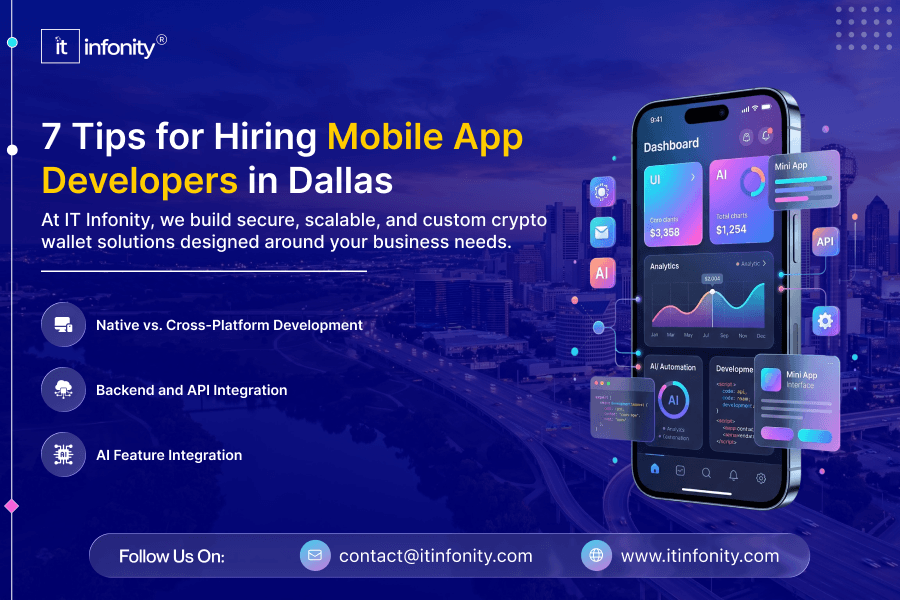
Native vs. Cross-Platform Development
A native app is built separately for iOS and Android using each platform’s own language; a cross-platform app (built with tools like Flutter or React Native) shares one codebase across both.
Backend and API Integration
Anything involving accounts, payments, or real-time data — think chat, maps, or location scanning — needs a backend server and APIs connecting the app to that data.
AI Feature Integration
Features like image recognition, smart matching, or conversational assistants require connecting the app to a trained model or AI API, which is a distinct skill set from standard app development.
How Much Does Mobile App Development Cost in Dallas, TX?
Cost is usually the first — and most poorly answered — question in any first call with an agency. Vague answers (“it depends”) aren’t wrong, but they’re not useful for budgeting either.
Mobile app development cost is the total price to design, build, test, and launch an app. It works by scaling with feature count, platform choice, and backend complexity. Most commonly, a mid-sized business app costs $50,000–$120,000 in 2026.
Industry-wide data compiled from more than 5,000 app projects puts the average custom mobile app build at roughly $171,450 in 2025–2026, though most small-to-mid business apps land between $50,000 and $120,000 Kellton, 2026. Hourly rates for app developers commonly range from $25–$49 per hour, according to Clutch survey data reported by Sparxit Sparxit, 2026.
MVP vs. Full-Featured Build
An MVP (minimum viable product) with core functionality on one platform typically runs $25,000–$60,000 — the cheapest way to validate an idea before committing to a full build.
Native vs. Cross-Platform Cost Difference
Building cross-platform with Flutter or React Native instead of two separate native apps typically cuts costs by 30–50%.
What Services Should You Expect From a Dallas Mobile App Development Company?
Not every “app developer” offers the same scope. Knowing the full service list helps you spot gaps in a proposal before you sign anything.
Mobile app development services cover the full app lifecycle: UX/UI design, native or cross-platform engineering, backend and API development, QA testing, App Store/Play Store deployment, and post-launch maintenance. Most commonly bundled together by full-service agencies rather than sold separately.
A team that only hands off code without deployment support or post-launch maintenance leaves you exposed — apps typically need 15–20% of the original build cost annually just for updates, bug fixes, and OS compatibility.
How Do You Choose the Right Mobile App Development Company in Dallas, TX?
This is the step most buyers rush. A polished website and a confident sales call aren’t proof that a team can actually ship and maintain a working app.
Choosing a mobile app development company means verifying real, live work — not just a portfolio page. It works by checking published apps on the App Store or Google Play under the company’s name or support contact. Most commonly done by searching the developer’s support email or app listing directly.
As a first-hand example: you can verify IT Infonity’s work directly on Google Play — Tree Match and Real Singles Classic are both live, publicly listed apps, and their store pages show the same support contact, which is a simple way to confirm a team actually ships and supports what it builds, rather than only pitching concepts.
Questions to Ask Before Signing
- Can I see a live app you’ve built and supported, not just a design mockup?
- Who owns the source code and backend after launch?
- What’s included in post-launch support, and for how long?
What Role Does AI Play in Apps Built in Dallas Right Now?
AI features are one of the biggest cost and complexity swings in a 2026 app build, so it’s worth understanding what you’re actually paying for.
AI integration in a mobile app means connecting the app to a trained model or AI API for tasks like image recognition, recommendations, or chat. It works by processing user input (a photo, a query, behavior data) through the model in real time. Most commonly used for personalization, matching, and automated recognition features.
Adding AI features typically adds $15,000–$80,000 on top of a base build, depending on whether the team uses existing AI APIs or builds and trains a custom model Metafied Lab, 2026. That range is exactly why it matters to work with a team that has already shipped AI features in production — like image-based tree recognition or behavioral matching — rather than one quoting AI work for the first time.
Original Insight
Having built and supported AI-powered apps across two different categories — dating/social matching and nature/environmental scanning — IT Infonity’s experience points to the same pattern in both: the AI feature itself is rarely the hard part. The hard part is the unglamorous work around it — data handling, app store data-safety disclosures, and keeping the model’s real-world accuracy consistent across devices — which is exactly where many budget quotes leave gaps.
Conclusion
Choosing among mobile app development companies in Dallas, TX comes down to three things: understanding what’s actually included in a quote, knowing where your budget realistically falls ($50,000–$120,000 for most mid-sized business apps), and verifying that a company has shipped and supported real, live apps — not just pitched concepts. Dallas’ growing tech ecosystem means more options than ever, which makes that verification step more important, not less.
Call to Action
Ready to scope your app? Contact IT Infonity to talk through your project and get a straight answer on cost and timeline.
Author Bio
IT Infonity is a Dallas, TX-based mobile app development team specializing in AI-powered mobile apps. The team’s published, live work includes Tree Match, an AI tree- and soil-scanning app on Google Play, and Real Singles Classic, an AI-driven matchmaking app also on Google Play.