
AI is changing how businesses build products, automate operations, interact with customers, and use their data. But turning an AI idea into a reliable business solution requires much more than connecting an application to an AI model.
Successful AI development combines business strategy, data, AI models, software engineering, integrations, security, testing, deployment, and continuous optimization.
In this guide, we’ll explain how AI development works, what businesses can build with AI, which technologies and architectures are commonly used, how much AI development can cost, how long projects can take, and what to look for when choosing an AI development partner.
What Is AI Development?
AI development is the process of designing and building software that uses artificial intelligence to perform tasks such as understanding language, analyzing data, generating content, recognizing patterns, making predictions, automating workflows, or assisting users with complex tasks.
Depending on the business problem, an AI solution may use:
- Machine learning
- Generative AI
- Large language models
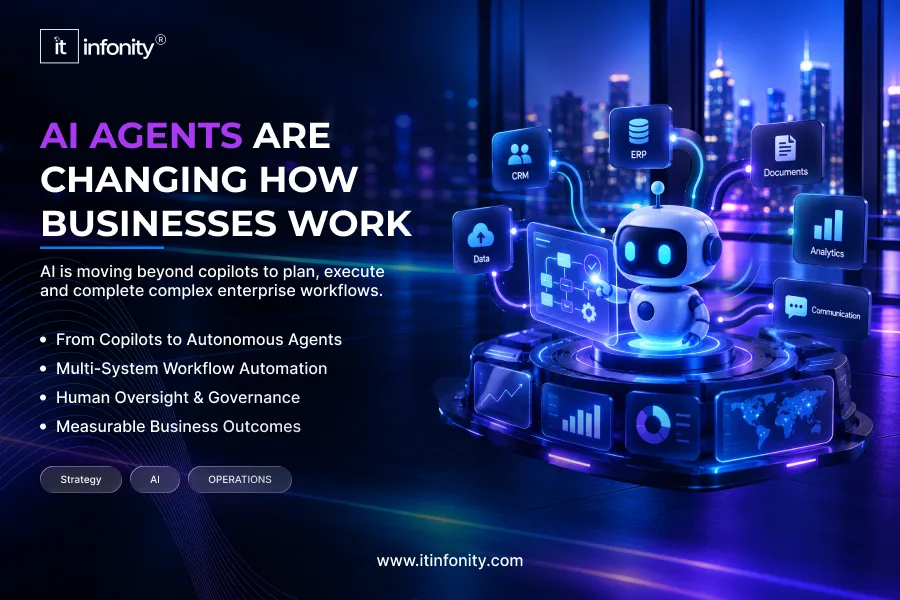
- AI agents
- Natural language processing
- Computer vision
- Predictive analytics
- Recommendation systems
- Retrieval-augmented generation
- Intelligent automation
The goal isn’t to add AI simply because the technology is available.
The goal is to use AI where it can create measurable business value.
Why AI Development Matters for Businesses
Automate Repetitive Processes
AI can process documents, classify information, answer repetitive questions, summarize data, and automate multi-step workflows.
Improve Customer Experience
AI assistants, intelligent search, recommendation engines, and conversational applications can make digital experiences faster and more personalized.
Turn Business Data Into Intelligence
AI can analyze structured and unstructured data to identify patterns, generate insights, and support decision-making.
Build AI-Powered Products
AI can become a core part of a SaaS product, mobile application, enterprise platform, or entirely new digital product.
Reduce Operational Workload
AI can augment employees and automate repetitive tasks so teams can focus on higher-value work.
What Can You Build With AI?
Generative AI Applications
Build applications capable of generating and transforming text, images, audio, code, and other content.
AI Agents
Develop systems that can understand goals, retrieve information, use tools, interact with APIs, and complete multi-step workflows.
AI Chatbots
Create conversational experiences for customer support, sales, internal knowledge, and product assistance.
AI Copilots
Give employees or customers contextual AI assistance directly inside existing applications and workflows.
Machine Learning Systems
Build predictive models for forecasting, recommendations, classification, anomaly detection, and other data-driven applications.
Computer Vision Solutions
Analyze images and video for inspection, classification, recognition, monitoring, and automation.
NLP Applications
Extract, classify, summarize, translate, and analyze information contained in natural language.
AI-Powered Search
Create semantic and conversational search experiences that understand context and intent.
AI Development Services
AI Strategy & Consulting
Identify practical AI opportunities, evaluate feasibility, define architecture, and develop an implementation roadmap.
Custom AI Development
Build AI-powered software around your business requirements, data, users, workflows, and technology environment.
Generative AI Development
Develop LLM-powered applications, RAG systems, AI assistants, multimodal applications, and intelligent content solutions.
AI Agent Development
Build AI agents capable of interacting with tools, business systems, APIs, databases, and knowledge sources.
Machine Learning Development
Develop predictive and data-driven solutions for forecasting, classification, recommendations, anomaly detection, and analytics.
AI MVP Development
Validate an AI product idea with a focused MVP before investing in full-scale development.
AI PoC Development
Test technical feasibility, model performance, data requirements, and architecture before building the complete solution.
AI Integration & Automation
Integrate AI capabilities into existing websites, mobile apps, CRMs, ERPs, databases, and business workflows.
AI Development Technologies
Large Language Models
OpenAI, Anthropic, Google Gemini, Meta Llama, Mistral
AI & Machine Learning
PyTorch, TensorFlow, Scikit-learn, Hugging Face
AI Application Frameworks
LangChain, LlamaIndex, Haystack, AutoGen
Vector & Data Technologies
PostgreSQL, pgvector, Pinecone, Weaviate, Milvus
Cloud Platforms
AWS, Microsoft Azure, Google Cloud
Application Development
Python, Node.js, Java, .NET, React, Next.js, React Native, Flutter
How We Choose AI Technologies
The most popular AI technology isn’t automatically the best technology for every project.
We evaluate:
- Business requirements
- Model capabilities
- Data availability
- Accuracy requirements
- Security
- Latency
- Scalability
- Integration requirements
- Infrastructure
- Operating costs
- before selecting an architecture.
RAG vs Fine-Tuning vs AI Agents
Businesses often ask which AI approach they should use.
RAG
Best when an AI application needs to retrieve information from private or frequently changing knowledge sources.
Fine-Tuning
Useful when specialized model behavior or consistent domain-specific output is required.
AI Agents
Useful when AI needs to perform tasks, use tools, access systems, or complete multi-step workflows.
Traditional Machine Learning
Better suited to many prediction, classification, forecasting, and recommendation problems.
Custom AI Application
Useful when AI needs to become a core component of a product or complex business workflow.
There isn’t one AI architecture that works for every business problem.
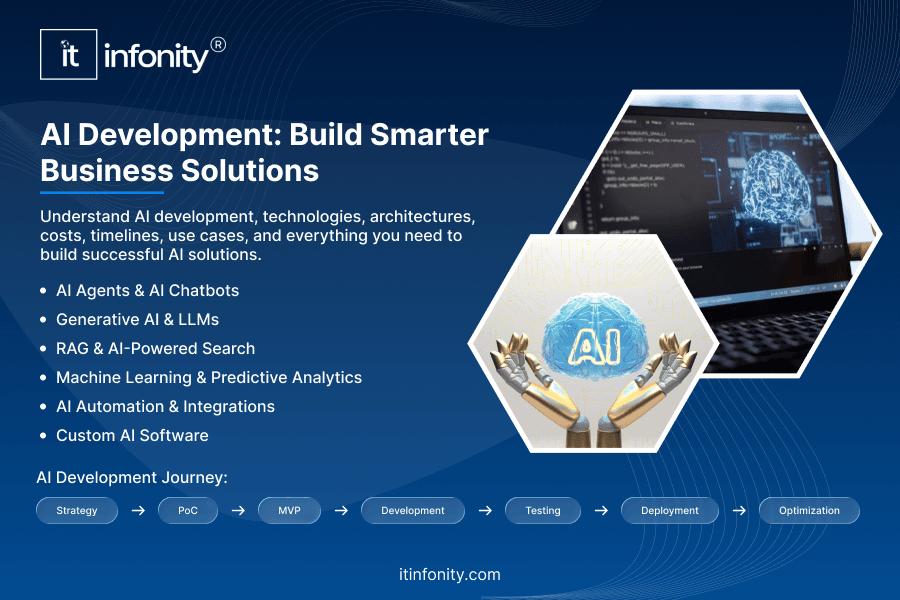
How AI Development Works
1. Business Discovery
Understand the business problem, users, workflows, existing systems, and desired outcomes.
2. AI Feasibility
Evaluate data, technical requirements, AI suitability, expected performance, and potential risks.
3. Architecture
Design the AI models, application architecture, data layer, APIs, integrations, security, and infrastructure.
4. Proof of Concept
Validate the most technically uncertain part of the solution.
5. MVP Development
Build the core functionality required to validate the product or use case.
6. AI Evaluation
Test accuracy, relevance, hallucinations, latency, reliability, security, and cost.
7. Production Deployment
Deploy the solution and integrate it with the required business systems.
8. Monitoring & Optimization
Track AI performance, usage, quality, cost, and changing requirements after launch.
AI Development Cost
AI PoC
Designed to validate whether the core AI concept works.
AI MVP
Designed to validate the product, workflow, and user experience.
AI Product
Designed for real users, integrations, scalability, security, and long-term operation.
What Determines AI Development Cost?
- Project complexity
- Data preparation
- AI model selection
- RAG requirements
- Fine-tuning
- Number of integrations
- UI/UX complexity
- Backend development
- Security
- Cloud infrastructure
- AI evaluation
- User volume
- Maintenance
- AI Development Timeline
IT Infonity’s existing AI guidance indicates that fine-tuned model projects can take around 6–8 weeks, while comprehensive full-scale AI systems can take up to approximately 16 weeks, depending on scope and requirements.
Real-World AI Experience at IT Infonity
IT Infonity highlights:
- 700+ AI solutions delivered
- 30+ enterprise AI implementations
- 500k+ business processes automated
- 15+ industry-focused AI solutions
- 98% client satisfaction and retention
- 8+ years of AI and technology experience
These figures demonstrate experience across AI implementation, automation, enterprise solutions, and industry-specific applications.
IT Infonity also brings 15+ years of overall technology experience, providing a broader software-engineering foundation for AI projects.
AI Projects & Experience
TreeMatch
An AI-driven tree recommendation platform that uses location and soil-related information to help users make better tree-selection decisions.
Sphiri
An intelligent home-management platform designed to centralize household activities and vendor information.
PawQuote
A pet-insurance comparison platform designed to help users compare insurance options and receive real-time quotes.
Explore IT Infonity’s AI Projects
AI Use Cases by Industry
Healthcare
AI-powered workflow automation, document processing, analytics, intelligent search, and digital experiences.
Financial Services
Fraud-related analysis, document intelligence, risk workflows, automation, and customer support.
Retail & eCommerce
Recommendations, personalization, conversational commerce, search, forecasting, and customer engagement.
Logistics
Forecasting, operational optimization, document processing, and workflow automation.
SaaS
AI copilots, intelligent search, AI agents, automation, analytics, and AI-native features.
How to Choose an AI Development Company
This is another high-value commercial section that many generic AI articles don’t do well.
Before choosing a development partner, evaluate:
Relevant AI Experience
Does the company have experience with the AI technology and business problem you need to solve?
Software Engineering Capability
Can they build the complete product—not just an AI prototype?
Case Studies
Can they demonstrate actual AI projects?
Technical Approach
Can they explain why they recommend RAG, fine-tuning, AI agents, ML, or another approach?
AI Evaluation
How do they test model performance and reliability?
Security
How will your business and customer data be protected?
Post-Launch Support
Will they monitor and optimize the AI system after deployment?
Build vs Buy vs Integrate
A business doesn’t always need a completely custom AI system.
| Situation | Suitable approach |
| Basic chatbot | Existing AI platform |
| Private knowledge assistant | RAG |
| Multi-step workflow | AI agent |
| Specialized behavior | Fine-tuning |
| Predictive ro | Machine learning |
| AI as core product capability | Custom AI application |
The Right AI Strategy Is Not Always the Most Complex One
A good AI development partner should be willing to recommend an existing solution when it is more practical.
The objective should be:
Business value + reliability + scalability + security + manageable cost
—not maximum technical complexity.
Common AI Development Mistakes
Building AI Before Defining the Problem
Technology should follow the business objective.
Ignoring Data Quality
Poor data can limit the effectiveness of even powerful models.
Skipping AI Evaluation
AI applications need systematic testing beyond traditional software QA.
Focusing Only on Model Accuracy
Latency, cost, security, reliability, and user experience also matter.
Building an Overly Complex Architecture
Not every project needs multiple agents, custom models, or elaborate infrastructure.
Forgetting Post-Launch Monitoring
AI applications need continuous observation and optimization.
The Future of AI Development
AI development is moving from isolated AI features toward intelligent systems embedded within complete business workflows.
The next generation of AI applications will increasingly combine:
- Generative AI
- AI agents
- Multimodal models
- Intelligent automation
- AI-powered search
- Predictive analytics
- Enterprise knowledge systems
- AI copilots
The biggest opportunity isn’t simply making software capable of generating content.
It’s building software that can understand context, make useful decisions, interact with business systems, and help complete real work.
Final Takeaway
AI development is not simply about choosing an AI model and connecting it to an application.
A successful AI solution combines:
Business Strategy + Data + AI Models + Software Engineering + Integrations + Security + Evaluation + Continuous Optimization
The right approach depends on what you are trying to accomplish.
For some businesses, an existing AI platform may be enough. Others may benefit from RAG, AI agents, fine-tuning, machine learning, or a fully custom AI application.
The most successful AI projects start with a clearly defined problem, validate the approach early, measure performance carefully, and continuously improve after deployment.
Want to Turn Your AI Idea Into a Working Product?
IT Infonity helps startups, growing businesses, and enterprises plan, develop, integrate, and optimize AI-powered software solutions.
With experience across AI applications, enterprise implementations, intelligent automation, generative AI, and AI-powered products, our team can help you identify the right technical approach for your business.