

Technology has become part of almost every area of daily life. We use mobile apps to manage schedules, communicate, organize tasks, learn new things, and make everyday decisions.
Family life is different.
It has to do with routines, relationships, communication, shared tasks, values, and small things that form the connection within the family. This means that technology that focuses on the family should be able to do more than bring another feature into the digital sphere.
AI-based mobile applications have started looking at the ways in which technology can support the day-to-day processes and make them more relevant and useful to the family through creating connections and fostering good communication.
What Are AI-Powered Mobile Apps for Families?
Family applications with AI use the combination of mobile technology and artificial intelligence to create better personal experiences for the users as part of a family.
Rather than providing all users with the same information and suggestions, AI can use the context and user-specific information to improve their experience.
Depending on the purpose of the app, this could include:
- Personalized activity suggestions
- Family routines and reminders
- Conversation prompts
- Personalized recommendations
- Reflection and journaling
- AI-powered guidance
- Shared family goals
- Communication tools
- Family organization
The goal is not to replace family interaction with technology. It is to use technology as a supporting layer around the everyday experiences that help families stay connected.
Why Mobile Apps Fit Everyday Family Life
Family routines rarely happen in one place.
Parents may manage schedules from their phones, children may use different devices, and family members may have different routines throughout the day. A mobile app can bring relevant information, activities, and resources into a single accessible environment.
This makes mobile technology particularly useful for family-focused experiences.
A well-designed family mobile app can help users:
- Organize everyday routines
- Keep track of shared activities
- Create opportunities for communication
- Reflect on family experiences
- Access personalized resources
- Stay connected when schedules are busy
The value comes from making these interactions simple enough to fit naturally into everyday life rather than adding another complicated task to an already busy schedule.
How AI Can Personalize Family Experiences
One of the biggest differences between traditional mobile apps and AI-powered experiences is personalization.
A conventional app may follow predefined rules. AI can potentially respond to changing context and patterns within the information users choose to provide.
For example, an AI system could consider:
- Family preferences
- Existing routines
- Previous interactions
- Selected values
- User goals
- Current context
This can help an app provide suggestions that feel more relevant instead of delivering the same experience to everyone.
For families, that personalization can make digital interactions feel less generic and more connected to the way they actually live.
However, personalization should have a clear purpose. Adding AI simply because it is a popular technology does not automatically make an app more useful.
The AI needs to solve a real user problem.
AI Can Support Communication and Connection
Communication is one area where AI-powered mobile apps can provide useful support.
Families may have busy schedules, different communication styles, or limited opportunities to sit down together. A digital experience can create small prompts and activities that encourage conversation without trying to replace it.
For example, an app could suggest:
- Conversation starters
- Shared activities
- Reflection questions
- Family check-ins
- Personalized discussion topics
These small interactions can create opportunities for family members to pause, talk, and reconnect during an otherwise busy day.
The important distinction is that AI can create opportunities for interaction, while the actual relationship remains between family members.
That makes the technology a facilitator rather than a substitute for human connection.
Supporting Better Family Routines
Routines are another practical area for family technology.
Morning schedules, meals, activities, school responsibilities, household tasks, and time together can all become easier to manage when they are organized around a family’s actual lifestyle.
AI can potentially help by identifying patterns and making relevant suggestions.
For example, instead of simply displaying a generic routine, a personalized system could help families think about what activities fit their schedule, priorities, and preferences.
When routines become easier to organize, families may have more space for the interactions that happen around them.
This turns a mobile app from a basic planning tool into a more adaptive digital experience.
Family Culture, Reflection and Shared Values
Family life is not only about schedules.
Families also develop shared values, traditions, communication patterns, and ways of handling difficult moments. These less tangible aspects can be difficult to represent in traditional productivity apps.
Technology can support this area through reflection tools, prompts, shared goals, and structured activities.
For example, families might use a digital experience to reflect on:
- How connected they feel
- How they communicate
- How they manage routines
- How much independence family members have
- How they handle conflict and repair
- What gives their family meaning
The purpose is not to measure family life as a score. Instead, structured reflection can help families notice patterns and create space for conversations they may otherwise overlook.
Over time, these small moments of reflection can contribute to a stronger sense of connection and shared understanding.
Why User Experience Matters in Family Apps
Even a technically advanced AI-powered mobile app can fail if it is difficult to use.
Family technology often needs to fit into already busy lives. Users should not need to spend significant time learning how the product works before receiving value from it.
Good family app UX should focus on:
- Simple navigation
- Clear information
- Short and useful interactions
- Accessible mobile design
- Relevant personalization
- Consistent visual language
- Minimal friction
The interface should support the experience rather than become another task for the user.
This is especially important when AI is involved. Users need to understand what the AI is doing, why a recommendation was provided, and what control they have over the experience.
When the technology feels simple and relevant, it has a better chance of fitting naturally into everyday family life.
Privacy and Responsible AI Matter
Family-focused applications can involve personal information, preferences, routines, conversations, and other sensitive context.
That makes privacy an important part of AI-powered mobile app development.
Developers need to consider:
- What data is collected
- Why the data is needed
- How it is stored
- Who can access it
- How users control their information
- How AI processes user-provided context
- How children and family members are protected
AI should be designed with transparency and appropriate safeguards from the beginning rather than treated as an issue to solve after development.
For family technology, trust is part of the product experience. Without it, even useful features may struggle to become part of everyday family life.
What Does It Take to Build an AI-Powered Family App?
Building this type of application requires more than adding an AI chatbot to a mobile interface.
The development process can involve several connected areas.
1. A Clear Problem That Needs Solving
The next step is knowing the actual problems that the families have.
The solution does not need to be AI-related unless there is a valid use case for using AI.
2. Appropriate Role for AI
Artificial intelligence may be used for personalizing the experience, making recommendations, generating content, providing guidance, classifying something, and for the conversational experience.
It all depends on what kind of product you are creating and what experience you want the users to have.
3. Mobile First Experience
The experience must be designed for use on the mobile phone or tablet since the use cases for the app may be during different times of the day and not at the desk.
4. Strong Backend Architecture
AI-driven products may need APIs, databases, user profiles, authentication, analytics, and integration.
A scalable design will allow the product to adjust to the increasing number of users without compromising the user experience.
5. Privacy and Security
Data about the family is sensitive and should be handled carefully.
Security, permissions, data management, and ethical AI considerations should be accounted for when designing and developing the product.
6. Continuous Improvement
AI-driven products are not perfect once they go live.
Various factors including user feedback, usage patterns, new AI functionalities, and evolving user needs may affect future iterations of the product.
A Real-World Example of Family-Focused Technology
The above-mentioned concepts are being implemented by means of family-oriented digital technologies.
The Everyday Family merges mobile technology, AI guidance, family rituals, reflection, activities, and community-oriented experiences into a single ecosystem.
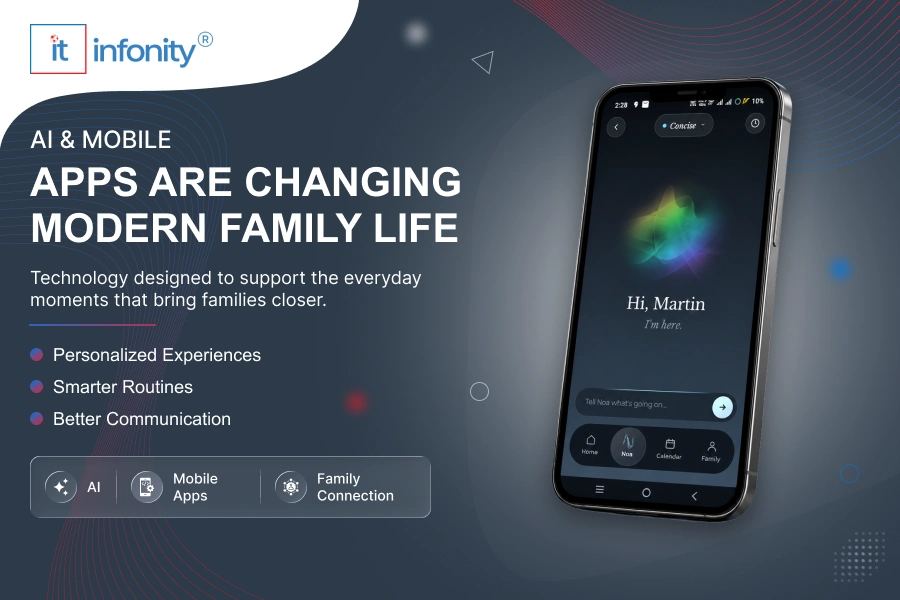
For instance, among the techniques utilized by The Everyday Family there are, for example, Daily Rhythms, which centers on daily rituals, and Noa, AI guide tailored specifically to family context and rhythms. Also, its Culture Pulse model emphasizes reflection on aspects like Connection, Structure, Autonomy, Repair, Rhythms, and Meaning.
All of the mentioned above are examples of the way AI and mobile technology can become supportive tools in family life without replacing human interactions.
The more general conclusion from all of the above can be stated as follows – family technology doesn’t necessarily have to be constructed upon some single AI functionality.
AI and Mobile App Development Work Together
Creating meaningful AI-powered mobile apps requires several disciplines to work together.
AI development helps create intelligent and personalized functionality. Mobile app development delivers that experience through accessible interfaces. Software engineering connects the different systems, while UI/UX design determines how naturally people interact with them.
For products designed around everyday family experiences, this combination is particularly important.
A technically advanced AI model is not enough if the mobile experience is confusing. Likewise, a beautiful app may provide limited value if the underlying intelligence does not solve a genuine user need.
Companies such as IT Infonity work across AI development, mobile app development, software engineering, and UI/UX to build digital products around specific user and product requirements.
Where Family Technology Could Go Next
AI-based family apps are yet to be developed fully.
With more sophisticated capabilities of AI being developed, the future iterations might be able to understand context, personalize suggestions, accommodate family’s daily routine and merge virtual and physical worlds through digital technologies.
The most useful developments are likely to focus less on simply adding more AI features and more on making technology feel relevant, responsible, and easy to use.
From the family’s perspective, it means that technology should help with everyday life without getting in the way too much, provide opportunities for communication and self-reflection and allow to get more out of the time spent together.
In the end, what will make these applications valuable would not be their AI capabilities. It would be the fact that they would help people to create meaningful experiences.
Final Thoughts
AI and mobile apps are changing what digital products can do in everyday life. For families, the opportunity is not simply to create another app, but to build technology that supports routines, communication, reflection, and connection in ways that feel useful and natural.
The strongest family-focused experiences are not necessarily the ones with the most AI features. They are the ones that understand the difference between supporting family life and trying to replace it.
When AI, mobile technology, thoughtful UX, and responsible product design work together, digital tools can become a practical part of modern family life while leaving the most important part where it belongs — with the people using them.