
SaaS platform
Clinical + operations
RAG + AI assistance
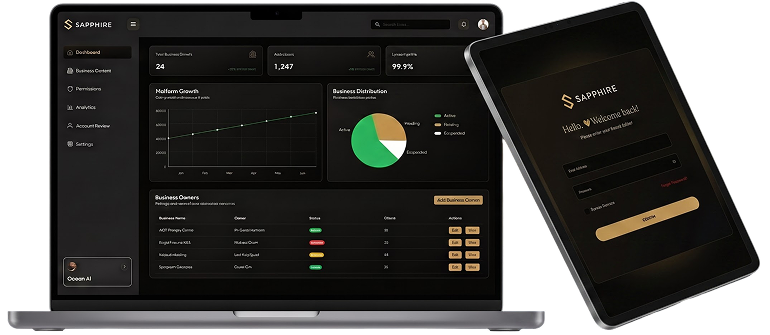
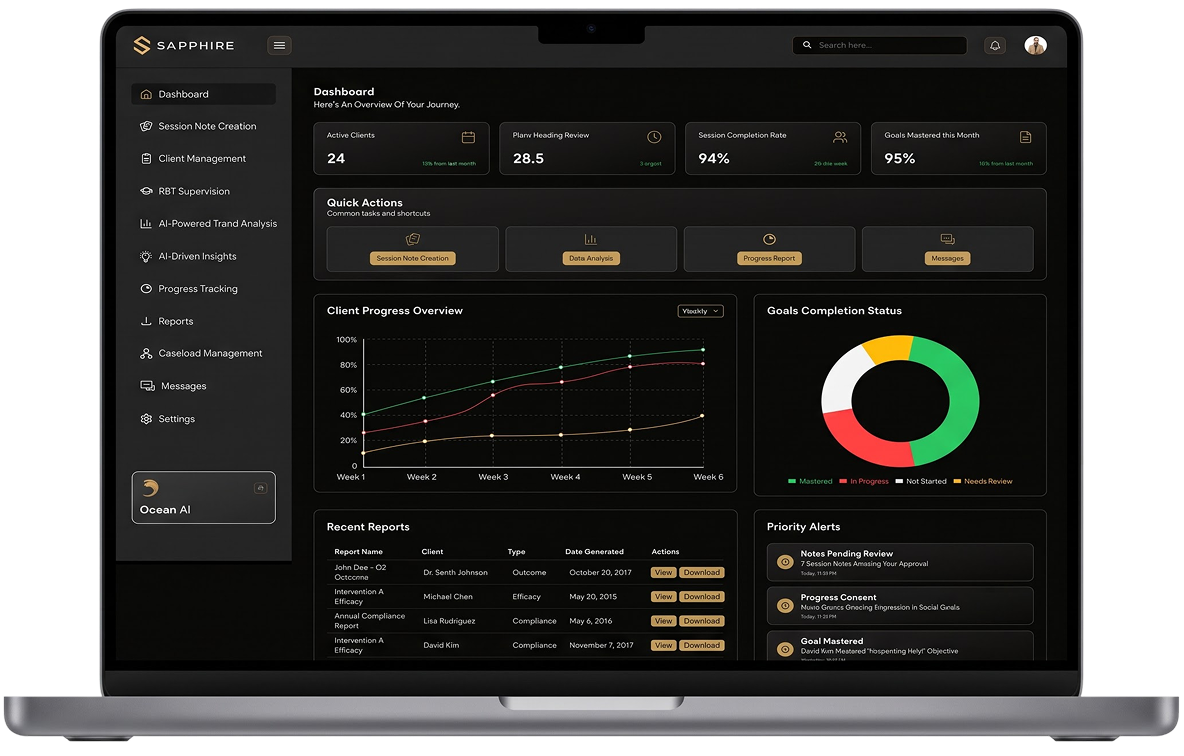
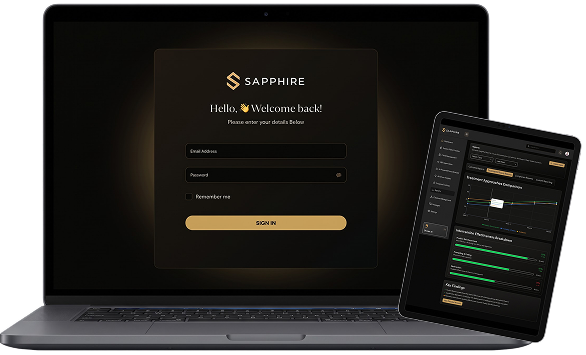
Sapphire AI is a specialized Software-as-a-Service (SaaS) platform conceived to modernize the operational and clinical workflows of Applied Behavior Analysis (ABA) practices.
Rather than asking practitioners to navigate disconnected tools for scheduling, session documentation, payroll, insurance billing, and progress monitoring, the solution brings essential activities into a coordinated digital environment. Its design serves practice owners, Board Certified Behavior Analysts (BCBAs), Registered Behavior Technicians (RBTs), billing teams, and families through role-specific experiences.
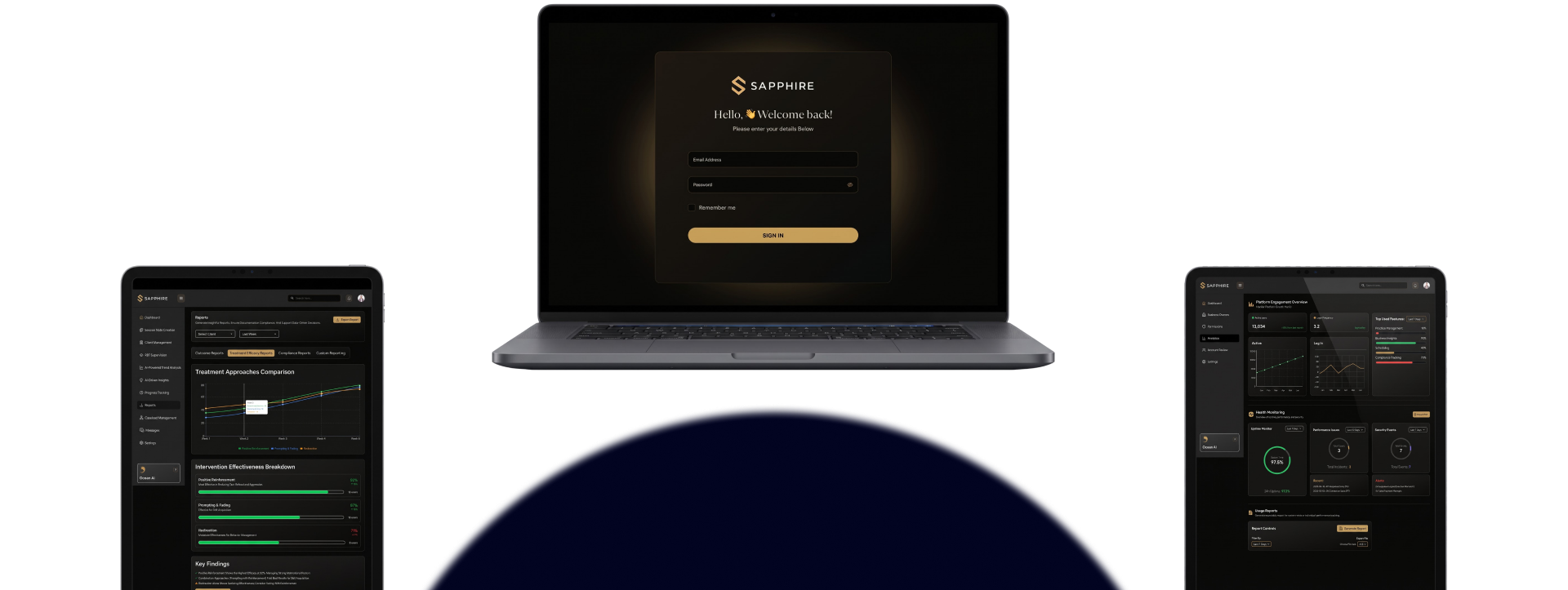
Session records, treatment plans, progress reporting.
Scheduling, staffing, timesheets, and billing workflows.
Context-aware documentation and workflow insights.
ABA organizations manage unusually complex relationships between care delivery and administration. A single appointment can affect therapist availability, client progress records, supervision requirements, timesheets, authorizations, and insurance claims.
Practice owners also need reliable visibility into revenue, staffing, utilization, and compliance deadlines without compromising access to sensitive client information. Sapphire AI addresses these interdependent needs as one connected product challenge, not as a collection of isolated software screens.
Practice accounts, subscriptions, platform settings, and audit activity.
Staff, clients, appointments, payroll, claims, and business performance.
Clinical reviews, supervision, treatment plans, and progress reports.
Session activities, behavior observations, and goal progress documentation.
Appointments, claim status, payments, and administrative workflows.
Accessible session summaries, appointments, and progress reports.
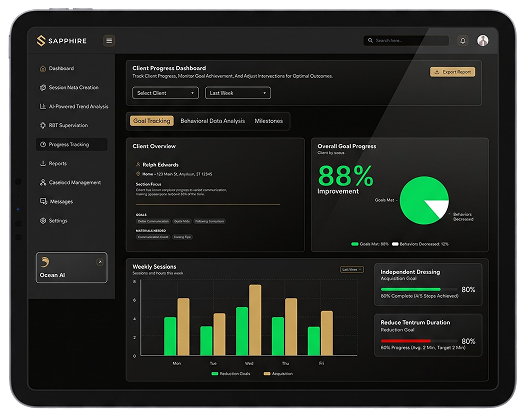
At the clinical layer, Sapphire AI is designed to streamline session documentation while keeping clinicians in control. RBTs can record activities, target behaviors, reinforcement strategies, ABC (antecedent–behavior–consequence) observations, and goal progress through structured templates. BCBAs can review those entries, add professional observations, oversee supervision activity, update treatment plans, and generate audience-appropriate reports. AI-assisted note drafting uses logged session information to prepare editable documentation rather than replacing professional review. Goal-based graphs and trendlines make changes in frequency, duration, intensity, and skill acquisition easier to interpret. This combination supports more consistent records and better-informed conversations between therapists, supervisors, and families.
An important part of the proposed technology approach is Retrieval-Augmented Generation (RAG). RAG combines language-model generation with retrieval of relevant, authorized reference material, helping AI outputs stay grounded in practice-specific context. Within Sapphire AI, a RAG-enabled assistant can be designed to surface approved treatment-plan information, documentation guidance, policy references, or historical session context when preparing summaries and answering workflow questions. Retrieval must respect tenant boundaries and user permissions; sensitive information should never become globally searchable. AI suggestions remain reviewable, with clinicians and administrators responsible for final clinical and financial decisions. The project specification also describes AI-based behavioral trend analysis, payroll anomaly alerts, and claim validation, which together define a broader decision-support roadmap.
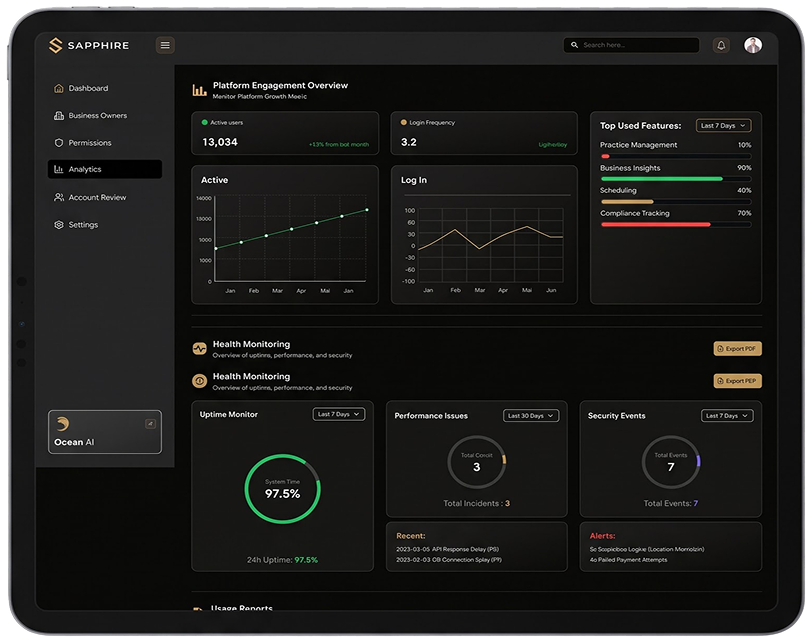
Scheduling connects care delivery with day-to-day business operations. Sapphire AI supports recurring appointments, therapist assignment by availability and credentials, calendar synchronization, reminders, and conflict detection. Staff can track session time, preparation, travel, and administrative work, with recorded hours linked to relevant client sessions. Managers can review timesheets and prepare payroll reports. A proposed AI discrepancy-detection layer compares logged hours with scheduled and completed sessions, identifying potential over-reporting, under-reporting, missed entries, and irregular breaks. Instead of silently changing compensation records, the system can flag exceptions for investigation and suggest corrective actions. This makes payroll review more transparent and gives administrators an earlier opportunity to resolve inconsistencies.
Discover how Sapphire AI brings clinical documentation, appointment scheduling, billing workflows, progress tracking, and AI-powered assistance together in one connected platform. Book a personalized demo to explore its features and see how intelligent technology can simplify everyday practice operations.
For billing teams, Sapphire AI connects clinical documentation to the reimbursement lifecycle. Claim generation can draw from session records, provider information, service codes, and authorizations. Staff can inspect submission status, review denials, reconcile insurer payments, manage client balances, and produce financial reports.
The documented AI capabilities include detecting duplicate claims, identifying missing documentation, checking code and modifier consistency, and suggesting corrections to claims at risk of denial. These features are positioned as assistance for qualified billing staff, not guarantees of payer approval. The broader workflow is designed to reduce repetitive data entry, improve the completeness of submissions, and give practice leaders clearer visibility into accounts receivable and revenue trends.
Stripe is included as the payment gateway for the SaaS commercial layer. A suitable integration can support practice subscription plans, recurring billing, payment-status synchronization, invoices, and renewal workflows, with webhook events updating the platform’s subscription records.
Stripe is included as the payment gateway for the SaaS commercial layer. A suitable integration can support practice subscription plans, recurring billing, payment-status synchronization, invoices, and renewal workflows, with webhook events updating the platform’s subscription records. Stripe can also be considered for eligible practice payment collection flows where the business model and regulatory requirements permit. The source specification calls for business-owner subscription visibility and payment management, but does not confirm final pricing tiers or completed gateway implementation. Accordingly, this case study presents Stripe as part of the defined solution architecture rather than claiming live payment volumes or financial results.
Reduce fragmented processes and duplicate data entry.
Make clinical progress and operational issues easier to review.
Surface scheduling, documentation, and payroll exceptions for review.
Support incremental product enhancements and additional integrations.
Earlier alerts can help administrators investigate payroll anomalies, expiring credentials, missing claim details, and scheduling conflicts before they become larger problems. Practice-wide dashboards can support more informed resource planning and financial oversight. These are anticipated benefits of the described capabilities; the supplied requirements do not provide validated before-and-after metrics, customer adoption figures, or measured return on investment.
Expand payer integrations, improve analytics, and introduce carefully governed AI assistance for additional practice workflows.
Identify user roles, practice boundaries, critical workflows, and documentation requirements.
Prioritize high-frequency tasks such as recording sessions, approving timesheets, reviewing claims, and finding reports.
Establish consistent data models, APIs, access controls, and integrations.
Evaluate generated documentation, retrieval quality, and proposed anomaly alerts against representative scenarios.
Test permissions, scheduling conflicts, billing exceptions, audit trails, and AI output quality.
These stages reflect the implementation approach described in the supplied document; they should not be presented as completed milestones unless confirmed.
Sapphire AI represents a thoughtful approach to a demanding healthcare software category: connecting the people, records, decisions, and financial processes that make ABA practices run. Its proposed blend of role-specific interfaces, clinical documentation, operational automation, AI assistance, and secure payment infrastructure creates a scalable foundation for practice management. By pairing Angular and React with Python, Node.js, PostgreSQL, RAG, and Stripe, the platform architecture balances user experience, structured operations, intelligent support, and SaaS monetization. Above all, the product vision keeps technology in service of practitioners and families making essential work more coordinated, visible, and manageable as organizations grow.
From intelligent automation to connected digital platforms, IT Infonity helps transform ambitious ideas into scalable solutions built around your business needs.
It infonity is a team of experienced professionals, who excel at solving various business challenges.
Demo Video
In production, your actual product demo video
would play here.
Embed a YouTube,
Vimeo,
or self-hosted video.

Our product experts will walk you through a personalized demo and help you find the perfect solution for your needs.
Fill in the details below and we'll get back to you shortly.