
AI Agents vs Traditional Automation: What’s the Difference? A Complete Business Guide for 2026

AI Agents vs Traditional Automation

For decades, businesses have used automation to improve efficiency, reduce operational costs, and eliminate repetitive manual work. From automated emails and invoice processing to customer relationship management and workflow approvals, traditional automation has become a core part of modern business operations. But the way companies think about automation is changing. Today’s businesses are not only looking for systems that complete tasks faster. They need solutions that can understand information, make decisions, adapt to changing situations, and support employees in solving complex problems. This shift has introduced a new generation of intelligent automation powered by artificial intelligence. AI agents are transforming the automation landscape by bringing reasoning, decision-making, and adaptability into business processes. Unlike traditional automation systems that follow predefined rules, AI agents can analyze situations, understand user intent, interact with different systems, and take actions based on business goals. According to McKinsey & Company, generative AI has the potential to create trillions of dollars in economic value annually, with significant opportunities across customer operations, software development, and business process improvement. This growth shows that AI is no longer just an experimental technology. Businesses are actively exploring how intelligent systems can improve productivity and create better customer experiences. However, this does not mean traditional automation has become outdated. In reality, both technologies solve different problems. Traditional automation remains highly effective for predictable, rule-based processes. AI agents are designed for situations where businesses need flexibility, reasoning, and intelligent decision-making. The real question for organizations is not: “Should we choose AI agents or automation?” The better question is: “Where should we use traditional automation, and where can AI agents create greater business value?” Understanding this difference is essential for companies planning their next stage of digital transformation.   Why Businesses Are Moving Beyond Traditional Automation Traditional automation was designed for processes that follow predictable patterns. A typical automation workflow looks like this: Trigger → Rule → Action For example: A customer submits a request. ↓ The system checks predefined conditions. ↓ The system performs the required action. This approach works extremely well for repetitive processes where the outcome is always predictable. Examples include: Sending automated emails Processing invoices Updating customer records Generating reports Managing approval workflows However, modern businesses operate in a much more complex environment. Organizations now manage: Thousands of customer conversations Multiple business applications Large volumes of structured and unstructured data Changing customer expectations Complex decision-making processes Many business situations cannot be solved through fixed rules. For example, a customer support system can automatically send a response when a ticket is created. But it cannot fully understand: Customer emotions Previous interactions Business priorities The urgency of the problem The best possible solution This is where AI agents provide a major advantage. AI agents combine automation with intelligence. They can analyze information, understand context, and determine what action should happen next. According to Deloitte research, organizations are increasingly investing in artificial intelligence and automation technologies to improve productivity, operational efficiency, and customer experiences. The goal is not to replace automation. The goal is to create smarter automation systems that can handle more complex business challenges.   What Are AI Agents? AI agents refer to intelligent computerized programs that carry out various activities, make choices and accomplish particular objectives without much intervention by people. In contrast to automation programs that act on predefined instructions, AI agents comprehend the objectives and the processes necessary for accomplishing them. A simple way to understand the difference: Traditional Automation: “Give me the rules, and I will execute them.” AI Agent: “Give me the goal, and I will determine the best way to achieve it.” For example, a traditional automation system may be programmed to send a follow-up email after a customer interaction. An AI agent can: Analyze the conversation Understand customer intent Review previous interactions Create personalized responses Update CRM information Schedule the next action This makes AI agents more similar to digital assistants rather than simple automation tools. How AI Agents Work AI agents combine multiple technologies to understand information, make decisions, and complete business tasks. Artificial Intelligence Models AI agents use advanced AI models, including large language models (LLMs), to understand human language and process information. These capabilities allow AI agents to: Understand customer questions Analyze documents Summarize information Generate recommendations Create business insights Context Understanding One of the biggest advantages of AI agents is their ability to understand context. Instead of analyzing only one input, AI agents can consider multiple sources of information. This includes: Customer history Previous conversations Business policies Product information Internal knowledge bases This allows AI agents to deliver more accurate and personalized results. Integration With Business Systems AI agents become more powerful when connected with existing business applications. They can integrate with: CRM platforms ERP systems Databases Customer support tools Internal knowledge systems Business APIs For example, a sales AI agent can analyze CRM information, identify potential opportunities, prepare customer insights, and help sales teams prioritize their next actions. Reasoning and Decision-Making The biggest difference between AI agents and traditional automation is their ability to reason. Traditional automation asks: “What rule should I execute?” AI agents ask: “What action will create the best outcome?” This allows AI agents to handle situations where there is no single predefined answer.   AI Agent vs Traditional Automation: Customer Support Example Imagine an online business receives this customer message: “My order has not arrived, and I need it before an important event next week.” Traditional Automation Approach A traditional system may: Identify the order number Check shipping information Send a standard delivery update The process is automated, but the response is limited. AI Agent Approach An AI agent can: Understand the customer’s urgency Review order information Check delivery options Analyze previous interactions Recommend the best solution Update the customer Escalate the issue when required The difference is not just completing a task. The difference is understanding the situation and making intelligent decisions.   What Is Traditional Automation? Traditional automation refers to software systems that complete tasks using predefined rules, workflows, and instructions. These

How Much Does AI Development Cost in 2026? Complete Pricing Guide

AI Development

Once you begin working on your AI idea, you may have noticed a very distinctive feature—highly different prices offered by different vendors for similar projects. Some companies might offer to create an AI project for $20,000, while others will name $200,000 or even more as the price of their work. But why do we see such differences? That’s because the AI development pricing formula is not a single one. Different AI solutions are aimed at different purposes, have their unique set of features, require specific types of data, integrations, and much more. A basic AI chatbot for responding to client requests is much cheaper than an enterprise AI system designed to automatize processes and analyze large volumes of data in a company. For example, in the US, businesses may spend anywhere from $15,000 on developing a basic AI MVP up to $500,000 and more on enterprise-grade AI software. It all depends on the type of the AI solution you need, its required customization and necessary skills of its developers. Before making any price comparisons and contacting companies offering AI development services, it might be wise to understand what exactly makes the cost of such projects vary.   How Much Does AI Development Cost in 2026?    The simplest way to calculate your budget is by considering the type of AI solution you would like to implement. An entrepreneur building an initial AI chatbot will not need the same budget as a hospital implementing an AI-based diagnosis system or a transportation firm creating a delivery route optimization software. The requirements of each project vary, hence the differences in the costs of development. Here is a realistic pricing guide for the most popular AI solutions in 2026. AI Solution Average Development Cost Typical Timeline AI MVP $15,000–$40,000 4–8 Weeks AI Chatbot $10,000–$60,000 1–3 Months AI Virtual Assistant $20,000–$80,000 2–4 Months Generative AI Application $30,000–$150,000+ 2–6 Months Machine Learning Software $40,000–$200,000+ 3–8 Months Computer Vision Solution $50,000–$250,000+ 4–9 Months Enterprise AI Platform $100,000–$500,000+ 6–12 Months Short Answer: The price to build custom AI is estimated within $30,000 to $150,000 range for the majority of companies. The small AI development projects like chatbots cost at least $10,000, but large-scale enterprise-level AI with complex automation, machine learning models, and integrations may be priced higher – even $500,000. This is not a fixed cost, but an estimation that depends on the scope of work. Additional features, integration with the company’s infrastructure, or creation of a customized AI require more time and resources.   Why AI Development Costs Can Be So Different    Let’s say two businesses ask an AI development company for a chatbot. The first business only wants answers to common customer questions and a contact form when the chatbot can’t help. The second wants the chatbot to recognize returning customers, pull order details from Shopify, create support tickets, recommend products, schedule appointments, and hand complex conversations to a human agent. Both are asking for an AI chatbot. But they’re not buying the same product. The second project involves more integrations, more testing, stronger security, and significantly more development work. That’s why the final price is much higher. This is true for almost every AI project. The more you expect the software to do, the more time it takes to design, develop, test, and maintain. Instead of comparing prices alone, it’s better to understand what you’re paying for. Once you know the biggest cost drivers, comparing quotes becomes much easier.   What Factors Affect AI Development Costs?   There’s no single factor that decides the cost of an AI project. The final budget is influenced by the features you need, the technology you choose, the quality of your data, and the amount of development work involved. Here are the biggest factors that affect pricing. 1. Project Complexity The biggest cost factor is the scope of the project. Development of a chatbot which will handle frequently asked questions is typically quicker to develop compared to software applications that involve document processing, report generation, multi-language capability, and integration with your existing enterprise systems. The implementation of each extra feature takes time for planning, development, testing, and quality assurance activities. This is the reason why even simple changes may impact the total price of your project. Project Type Estimated Cost Basic AI Application $10,000–$30,000 Medium Complexity AI Solution $30,000–$100,000 Enterprise AI Platform $100,000–$500,000+ A good way to control costs is to launch an MVP first. Build the features that solve the biggest problem, collect user feedback, and expand the product over time instead of trying to build everything at once. 2. The Type of AI Technology Different AI technologies require different levels of development effort. For example, building an AI chatbot with an existing large language model is usually faster than developing a custom machine learning system trained on your company’s own data. The same applies to computer vision, recommendation engines, and predictive analytics. Each solution requires different tools, different expertise, and different amounts of testing. AI Solution Cost Impact AI Chatbots Low to Medium Generative AI Applications Medium Recommendation Engines Medium Machine Learning Solutions High Computer Vision Applications High Custom AI Software Very High Rather than choosing the newest AI technology, focus on the one that solves your business problem in the simplest and most effective way. 3. Data Quality The value of AI systems depends upon the quality of data used for training or configuring these systems. In case the data in your company is not complete, up-to-date, or is in inconsistent formats, then the developers will be required to prepare and arrange this data first in order to train or configure the AI system. For instance, when you are developing an AI recommendation system for your online shop, then without cleaning the data regarding products’ names, categories, prices, and customers’ purchase histories, the AI system won’t be able to generate relevant recommendations. This process requires some time and time impacts the cost. Companies having good quality data spend less money as developers can concentrate only

How Much Does Mobile App Development Cost in 2026? Complete Pricing Guide

Mobile App Development Cost

Mobile apps have now turned into a necessary investment for organizations that want toMobile apps are an indispensable tool for any business that aims to develop customer relations and operations and generate more revenues. Irrespective of whether you are creating a startup MVP, eCommerce app, healthcare app, or enterprise application, knowledge of overall mobile development cost will help you plan your budget accordingly. In 2026, the price of developing a mobile app will vary depending on various factors such as complexity and type of the application, development platform, UI/UX design, backend infrastructure, integrations with other platforms, security issues, testing, and maintenance. Location from where the development process is conducted is also very important. American companies tend to spend more money on app development due to labor and operational expenses, while most organizations choose to collaborate with highly-experienced development teams from India in order to save budget. Instead of paying attention to the price of development only, it is necessary to take into consideration the total value of the project and its performance, security, scalability, maintenance, and UX.   How Much Does Mobile App Development Cost in 2026? The average mobile app development cost ranges from $5,000 to over $300,000, depending on project scope and technical requirements. Average Mobile App Development Cost  App Category Estimated Cost Basic Mobile App $5,000–$50,000 Medium Complexity App $50,000–$120,000 Enterprise Mobile App $120,000–$300,000+ AI-Powered Mobile App $100,000–$350,000+ Such costs normally cover planning, designing of user interface, front-end development, back-end development, testing, deployment, and project management. Software with high AI functionality, blockchain implementation, IoT features, and enterprise-level security normally cost more.   Mobile App Development Costs by Development Location Your choice of location for your development team is going to have a big impact on the total cost of your project. Salary costs for developers, operational costs, business rules, and local market conditions affect pricing. Companies operating in the USA spend more on mobile application development due to higher labor costs and operational costs. However, development companies with a lot of experience from India provide competitive pricing and create scalable, secure, and top-notch applications for international business organizations. When selecting a development company, you shouldn’t focus only on comparing the price per hour. There are other factors that will help your application succeed in the future. Average Hourly Mobile App Development Rates Development Role USA India Junior Developer $60–$100/hour $15–$25/hour Mid-Level Developer $100–$150/hour $25–$40/hour Senior Developer $150–$250+/hour $40–$75/hour UI/UX Designer $75–$180/hour $20–$50/hour QA Engineer $50–$120/hour $15–$40/hour Project Manager $80–$180/hour $25–$60/hour Rates vary depending on the developer’s experience, technology stack, project scope, and engagement model.  Average Project Cost by Application Type Project Type USA India MVP $30,000–$70,000 $5,000–$15,000 Startup App $50,000–$120,000 $15,000–$40,000 Marketplace App $80,000–$250,000 $25,000–$90,000 Healthcare App $60,000–$200,000 $20,000–$70,000 AI Mobile App $100,000–$350,000+ $35,000–$120,000+ Enterprise App $150,000–$500,000+ $40,000–$150,000+ These figures are estimates and will depend upon various factors including features needed, industry rules, integration needs, and the overall size of the project. Expert Insight from IT Infonity As per our experience in developing custom mobile applications, a good project starts from having a product strategy and not a bunch of features. The discovery process, defined user journey, and the technical planning at an early stage minimize the risk of development and save money.   Mobile App Development Cost by App Complexity Application complexity is one of the biggest factors affecting development costs. As functionality, integrations, and infrastructure requirements increase, so do development time and investment.  Basic Mobile Apps Estimated Cost USA India $20,000–$50,000 $5,000–$15,000 Typical Features  User registration and login User profile management Contact forms Push notifications Search functionality Basic admin dashboard Common Examples Business apps News apps Event apps Portfolio apps Local service apps Basic applications are ideal for businesses looking to establish a digital presence or launch a simple product with essential functionality. Medium-Complexity Mobile Apps Estimated Cost USA India $50,000–$120,000 $15,000–$40,000 Typical Features User authentication Payment gateway integration Booking systems Maps and GPS Chat functionality Push notifications Third-party API integrations Analytics dashboard Common Examples Food delivery apps Fitness applications Healthcare booking platforms Travel applications E-learning apps These applications require stronger backend architecture, more extensive testing, and integration with external services, increasing both development time and overall cost. Enterprise & AI-Powered Mobile Apps Estimated Cost USA India $120,000–$300,000+ $40,000–$150,000+ Typical Features Artificial intelligence and machine learning Video conferencing Real-time synchronization IoT integration Enterprise-grade security Cloud-native infrastructure Advanced analytics Multi-language support Large-scale databases Common Examples Banking applications Enterprise SaaS platforms Healthcare management systems Logistics and supply chain platforms AI-powered business solutions To build enterprise software solutions, you need experienced architects, expert developers, thorough testing and infrastructure.   Why Starting with an MVP Can Reduce Development Costs The use of MVP when launching a product helps businesses validate their idea by having some necessary features of the app rather than going all the way with the full development. Using MVP cuts down initial development costs and also helps in receiving valuable feedback from users. This helps in knowing which features to develop later in the product. It also helps in validating the market demand for the app.  This strategy is highly popular among new businesses and even established ones due to its benefits.   Mobile App Development Cost by Platform The development platform chosen will have a direct effect on development time, cost, maintenance, and scalability. It is important for a business to choose its development platform taking into account the audience that it intends to cater to.   Android App Development Cost Android is the most commonly used mobile operating system and hence becomes an obvious choice for a business aiming at targeting as broad an audience as possible. However, application optimization across multiple devices will become necessary. Estimated Cost Location Cost USA $25,000–$150,000+ India $8,000–$60,000+ Typical development timeline: 3–8 months iOS App Development Cost OS applications are commonly chosen by businesses targeting premium users and markets with high iPhone adoption, including the United States. Estimated Cost Location Cost USA $30,000–$180,000+ India $10,000–$70,000+ Development Time Frame: 3-8 Months   Cross-Platform App Development Cost (Flutter &

Agentic AI vs Generative AI: Key Differences, Use Cases & Business Benefits in 2026

Agentic AI vs Generative AI

The advent of automation of processes, better decision-making, and providing customer-centric experiences has made AI revolutionize various industries. The recent trends seen in the industry include the arrival of agentic AI and generative AI, which have emerged as some of the most popular technologies in the year 2026. While both of these types of AI technologies use complex models of AI, their purposes are quite different. The key feature of Generative AI is its ability to create various content, such as text, images, codes, videos, and audio based on users’ requests. In its turn, Agentic AI is a kind of advanced automation technology as it allows computers to plan, reason, make decisions, and perform tasks with minimal human involvement. The knowledge of the features of these technologies can help businesses select appropriate AI tools to enhance their performance. In IT Infonity, we assist start-ups, SMEs, and large companies in developing AI solutions that involve the best characteristics of Generative and Agentic AI.   What is Agentic AI?  Agentic AI represents the next level of artificial intelligence technology that can plan, decide, and perform several actions to complete a certain task independently. Unlike traditional AI technology which only operates in response to input, agentic AI performs actions through analyzing data and deciding on the right actions to take. An Agentic AI system can: Understand business objectives Break complex tasks into smaller steps Access APIs and databases Interact with enterprise applications Monitor progress Adapt based on new information Complete workflows with minimal human supervision For instance, an artificial intelligence-driven agent for customer service can perform such tasks as receiving a support query, analyzing customer data, prioritizing the concern, allocating the concern to the correct team, sending automatic replies, updating the CRM system, and informing relevant people all without any human intervention. Reasoning and acting skills make an agentic AI the perfect candidate for business automation.   What is Generative AI?  AI generation is all about making something anew from what you tell it to make. It uses language models and multimodal AI models for producing text, images, videos, audio, codes, and other digital material. Businesses use Generative AI for: Writing blogs and marketing content Creating social media posts Developing software code Designing graphics Producing product descriptions Generating emails and reports Building conversational AI chatbots However, as opposed to agentic AI, generative AI normally works based on prompts rather than completing the end-to-end workflow autonomously. The fast speed, creativity, and ability to produce high-quality content makes generative AI an important technology for marketing, engaging with customers, developing software, and producing content.   Agentic AI vs Generative AI: Comparison Table  Feature Agentic AI Generative AI Primary Purpose Execute tasks and achieve goals Generate content Autonomy High Limited Decision-Making ✔ Yes Limited Multi-Step Planning ✔ Yes ✖ No Workflow Automation End-to-end automation Content assistance Human Involvement Minimal Frequent API & Software Integration Extensive Limited Best For Business automation Content creation Business Impact Operational efficiency Creativity & productivity   Key Differences Between Agentic AI and Generative AI  1. Purpose While the function of Generative AI is to generate content quickly, Agentic AI is used for performing tasks that require the ability to set goals and complete them. Generative AI uses user prompts to generate responses, while agentic AI can analyze an environment and perform actions without being constantly controlled by a human operator. 2. Decision-Making Capacity The function of generative AI is to suggest or produce content but does not have the capacity to decide on actions to be taken. Agentic AI analyses available information and decides on the most appropriate action to be taken. 3. Workflow Execution  Generative AI enables the execution of individual tasks like drafting emails or coding. Agentic AI executes entire workflows. It can process customer inquiries, authenticate accounts, update information, notify customers, and close support tickets automatically. 4. Level of Automation Generative AI enhances efficiency through employee assistance for content generation and other routine tasks. Agentic AI provides greater automation through the replacement of routine processes with smart and purposeful processes. 5. Business Impact Generative AI aids in working faster to create quality content. Agentic AI revolutionizes businesses by increasing efficiency and accuracy through automation of processes. How Agentic AI Works  Agentic AI follows a structured process to accomplish business objectives. Understands the objective by analyzing the user’s request or business goal. Creates an execution plan by breaking the objective into manageable tasks. Uses external programs, such as API, database, CRM systems, and other enterprise software. Executes actions while monitoring progress in real time. Improve itself through the analysis of results and decision making for the future. The cycle above makes Agentic AI work like a smart digital assistan.   How Generative AI Works  Generative AI works through the use of highly advanced machine learning models trained on huge data sets to produce relevant outputs. The process includes: Receiving a user prompt Understanding context Predicting the most relevant response Generating text, images, code, or other content For example, a marketing team can ask Generative AI to create product descriptions, email campaigns, or advertising copy within seconds, significantly reducing content creation time while maintaining quality.   Real-World Examples of Agentic AI and Generative AI  Knowing about real-world applications enables companies to select the appropriate AI tool for themselves. Customer Support Generative AI: Creates personal email letters, sales proposals, and follow-up letters. Agentic AI: Qualifies the lead, schedules meetings with customers, updates CRM record, assign opportunities to the sales people. Sales & Lead Management Generative AI: Can create personalized sales email copy, product proposal, follow up copy. Agentic AI: Can qualify leads, schedule appointments, update CRM with customer information, assign opportunity to sales representative, and track customers’ interactions without requiring any human involvement. Software Development  Generative AI: Helps software developers write code, understand programming concepts, generate documentation, and find bugs. Agentic AI: Helps in managing the workflow of software development process through task assignments, project tracking, running automated tests, and managing the process of deployment. Human Resources  Generative AI: Can create job

AI Chatbot Development Services: Complete Guide for Businesses in 2026

AI Chatbot Development

Artificial Intelligence is transforming customer communications at the speed of light with the total value of the worldwide Artificial Intelligence market expected to grow over the mark of $1.8 trillion by the year 2030 according to the research of Grand View Research. “Development of AI Chatbot” has become one of the fastest ways for businesses to maximize their customer interactions and minimize costs. Modern-day customers desire immediate responses on websites, mobile devices, social networking sites, and instant messaging platforms. However, such high expectations from traditional customer support services can’t be met in a cost-effective way. Hence, the requirement of innovative solutions to improve customer service without adding to the staff expenses. In this guide, you will get to know everything about how AI Chatbot Development operates, its advantages for the business, process of development, recent trends, and good practices—free from any technical complexities. IT Infonity is an AI development company offering intelligent business automation, AI-based applications, enterprise-level chatbots, and AI software to startups and enterprises worldwide. What Is AI Chatbot Development and Why Does It Matter? In today’s world, AI chatbots do not only rely on pre-coded interactions but rather make use of Natural Language Processing, LLM, and Machine Learning to understand human intentions and provide appropriate responses. AI Chatbot Development refers to an AI-powered method of developing virtual assistants. The AI chatbot development process works via the use of NLP, Machine Learning, and large language models. AI chatbots are used by companies to provide services like customer support, sales, employee assistance, and workflow management. As per McKinsey & Company (2025), organizations adopting generative AI in their customer service processes gain improved productivity at reduced costs. Types of AI Chatbots : Rule-Based Chatbots Follow predefined conversation paths and decision trees. Best for: FAQs Appointment booking Basic customer support AI-Powered Chatbots Use Machine Learning and NLP to understand context. Best for: Customer service Sales conversations Personalized recommendations Generative AI Chatbots Powered by models like OpenAI GPT, Claude, Gemini, and Llama. Best for: Human-like conversations Content generation Technical assistance Knowledge management How Does AI Chatbot Development Improve Business Growth? Expectations of customers keep increasing. Companies need quick assistance but have to keep their operations costs under control. AI development helps companies to automate repetitive conversations without compromising on customer experience.  AI chatbot development boosts business growth through automation of customer engagement, reduced response time, increased lead generation, and assisting staff members. It works all the time and grows without requiring an increase in the size of the support team. Major Business Benefits 24/7 Customer Support Customers receive instant responses at any time. Increased Lead Generation AI qualifies visitors before routing them to sales teams. Lower Operating Costs Businesses automate repetitive conversations instead of hiring additional support staff. Better Customer Experience Personalized responses increase customer satisfaction. Omnichannel Support Deploy one chatbot across: Website WhatsApp Facebook Messenger Slack Microsoft Teams Mobile apps How to Build an AI Chatbot Development Solution? Development of the chatbot for organizations is not only concerned with implementing the AI technology itself, but there are many other aspects as well. Methodology of developing the chatbot through AI technology is very systematic and is characterized by several steps that include both planning and optimization. Step 1: Define Business Goals Examples include: Customer support Sales automation HR assistant Internal knowledge base Healthcare support Step 2: Choose the Right AI Model Popular options include: OpenAI GPT Google Gemini Claude Llama Mistral Step 3: Design Conversation Flow Focus on: User intent Context awareness Human fallback Error handling Step 4: Integrate Business Systems Typical integrations include: CRM ERP Help Desk Payment Gateway Inventory Management Booking Systems Step 5: Train and Test Improve chatbot accuracy using: Historical conversations FAQs Knowledge base Internal documentation Step 6: Monitor Performance Track: Resolution Rate CSAT Response Time Lead Conversion User Retention Which Technologies Power Modern AI Chatbot Development? AI chatbots in today’s world integrate multiple technological elements to provide human-like interactions. The development of modern AI chatbots makes use of NLP, machine learning, large language models, API, cloud computing, and vector database technology.   Technology Purpose Natural Language Processing Understand user intent Machine Learning Improve chatbot performance Large Language Models Generate responses Vector Database Store semantic knowledge Retrieval-Augmented Generation (RAG) Improve response accuracy Speech Recognition Voice conversations Cloud AI Services Scalable deployment Popular Frameworks LangChain LlamaIndex TensorFlow PyTorch FastAPI OpenAI API Google Vertex AI Azure AI AWS Bedrock What Are the Latest AI Chatbot Development Trends in 2026?  AI keeps progressing at a fast pace. Companies that use the current abilities of artificial intelligence have an advantage.  Among the current trends in the development of AI chatbots are: multimodal AI, AI agents, Retrieval-Augmented Generation, voice AI, automated workflows, and enterprise copilots. Top Trends: Agentic AI AI systems independently complete complex tasks. Voice AI Natural voice conversations replace text-only experiences. Multimodal AI Chatbots understand: Images Voice Documents Video Enterprise AI Copilots Employees receive AI assistance inside existing software.  Hyper-Personalization AI recommends products based on customer behavior. According to Gartner (2025), conversational AI will become a standard feature across digital customer service platforms. Industry Insight from IT Infonity Here at IT Infonity, we realized that the best AI chatbot projects always start from addressing an exact business problem rather than from automating everything from the very beginning. Companies that have integrated their chatbots into their CRM systems, knowledge bases, and processes have always been able to reach better results in terms of users’ adoption, satisfaction and ROI. Conclusion The development of AI Chatbots is emerging as an important area of investment for companies wanting to engage their customers better, automate processes, and save money. The choice of correct technology and process is key to achieving success in the long term. We create smart, scalable, and secure chatbot systems that fit your specific requirements at IT Infonity. Ready to Build an AI Chatbot for Your Business? Be it a customer service assistant, a sales chatbot, an enterprise copilot, or a conversational AI for any industry, get in touch with IT Infonity right

10 Best AI Agents You Can Use Right Now (Tested & Ranked)
ai agents in 2026

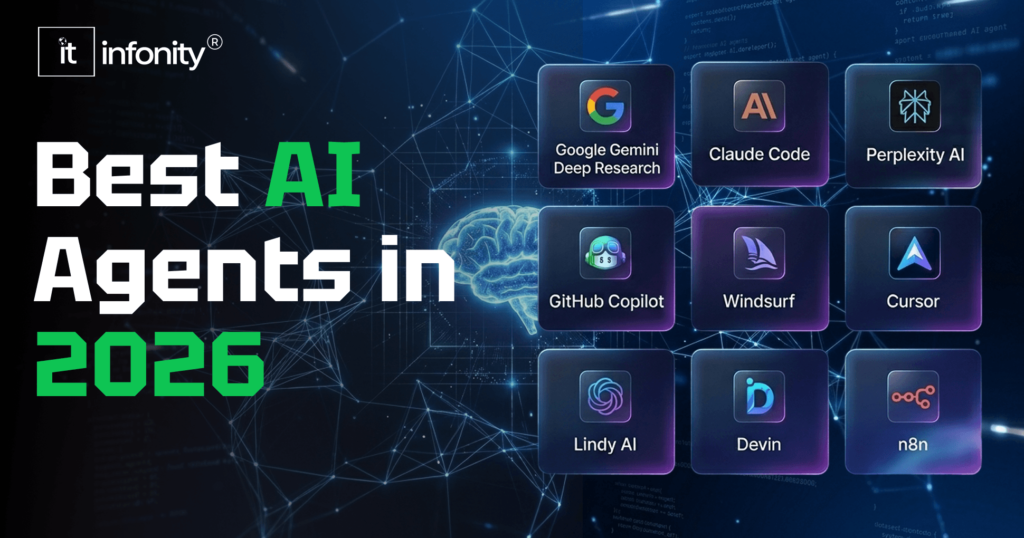
We tested over 25 AI agents across coding, research, email automation, and business workflows. Most were underwhelming. A few were genuinely useful. Ten made the cut. Whether you are a developer who wants to ship code faster, a business owner drowning in emails, or someone who just wants AI to actually do something instead of just talking, this list has the right tool for you. No hype. No filler. Just the 10 agents worth your time and money in 2026, ranked by what they do in the real world. What Is an AI Agent? An AI agent is a software system that can take actions on your behalf, not just answer questions. A regular AI chatbot responds to your message and stops. An AI agent reads your message, breaks it into steps, uses tools like search engines or code editors or your calendar, runs those steps in sequence, checks its own output, and then delivers a finished result. The difference is simple: chatbots talk, agents act. In 2026, agents can book meetings, write and run code, send emails, research topics with live web access, fill your CRM, and complete multi-step tasks that used to take humans hours. This guide covers the 10 best AI agents available right now, who each one is for, what it actually does, what it costs, and what its real limits are. How We Ranked These Agents Each agent on this list was evaluated on: Task completion: Does it actually finish the job or give up halfway? Real-world usability: Does it work outside of demo conditions? Pricing clarity: What does it actually cost per month? Who it is best for: Beginners, developers, or enterprise teams? Honest limits: What does it still get wrong? We did not use benchmark scores alone. Benchmarks tell you how an agent performs on test questions. This list tells you how they perform on work. The 10 Best AI Agents in 2026 These are the best 10 AI Agents in 2026: 1. Claude Code (Best for Developers: Terminal-Based Coding Agent) Best for: Software engineers who need autonomous, multi-file coding work done without leaving the terminal. What it does: Claude Code is Anthropic’s coding agent. You run it from your terminal, give it a goal like “build me a user authentication system” or “refactor this entire codebase to TypeScript,” and it works through the problem step by step. It writes code, runs tests, reads error messages, fixes bugs, and continues until the task is done. It handles the full software development lifecycle on its own. This includes writing tests, debugging failures, generating documentation, and navigating large codebases with millions of lines of code. Real-world result: At TELUS, engineering teams using Claude Code shipped code 30% faster while saving over 500,000 hours of developer time, averaging 40 minutes saved per AI interaction. Pricing: Pro: $20 per month Max: $200 per month (higher usage limits, access to Opus models) Real limits: Heavy usage with Opus models can cost $150 to $200 per month per developer Billing can feel opaque if you are not tracking token use Rate limits apply even on the $200 plan Verdict: The strongest autonomous coding agent available right now for engineers handling complex, multi-file, long-running tasks. 2. Cursor (Best AI Coding Agent for Daily Developer Workflow) Best for: Developers who want the fastest AI-assisted coding experience inside an IDE. What it does: Cursor is an AI-native code editor built on top of VS Code. It adds AI to every part of your editor: inline autocomplete, multi-file editing through Composer, and chat that understands your full codebase. Its autocomplete is the fastest in the category. If you write a comment explaining what you want, Cursor fills in the code. The Composer feature lets you describe a feature in plain language, and Cursor edits across multiple files at once to make it happen. Cursor uses Claude Opus under the hood for its most capable tasks, and you switch models depending on the complexity of what you are doing. Pricing: Free tier: basic autocomplete Pro: $20 per month Pro+: $39 per month Ultra: $200 per month Real limits: Cursor moved to credit-based billing in mid-2025, and heavy agent usage depletes credits faster than most developers expect Claude Opus burns credits faster than Sonnet Loses to Claude Code on very large codebases and long autonomous sessions Verdict: Best pick for developers who live inside their editor and want fast, daily AI pair programming. For massive autonomous tasks, switch to Claude Code. 3. ChatGPT with Operator Mode (Best General-Purpose AI Agent for Non-Developers) Best for: Anyone who wants an AI agent that can browse the web, run code, create files, and complete tasks through a simple chat interface. What it does: ChatGPT in 2026 is not just a chatbot. With Operator mode enabled, it can control a browser, fill out forms, book services, and complete multi-step tasks on websites on your behalf. It also has a built-in code interpreter, file creation, image generation, memory of past conversations, and web search. For everyday users who do not want to install developer tools, ChatGPT is the most capable general agent with the lowest barrier to entry. It has over 400 million weekly users as of early 2026, which means it is also the most tested and refined. Pricing: Free: basic chat, now includes ads in the US Plus: $20 per month Pro: $100 per month (access to all frontier models, more Operator usage) Real limits: Operator mode is still limited in what websites it can reliably control Free tier now serves ads in the US Does not match Claude Code or Cursor for serious coding tasks Verdict: The best single agent for general users who want one tool that does research, writing, coding help, file creation, and basic web tasks. 4. Perplexity AI (Best AI Agent for Research and Cited Information) Best for: Anyone who needs accurate, sourced answers with real-time web access, fast. What it does: Perplexity is a research agent. You ask it a question