
The advent of automation of processes, better decision-making, and providing customer-centric experiences has made AI revolutionize various industries. The recent trends seen in the industry include the arrival of agentic AI and generative AI, which have emerged as some of the most popular technologies in the year 2026. While both of these types of AI technologies use complex models of AI, their purposes are quite different.
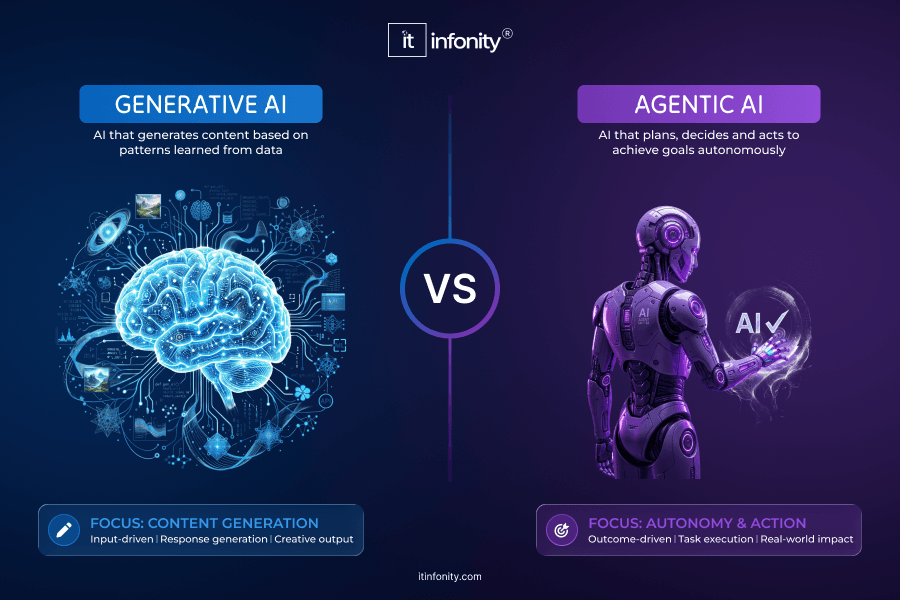
The key feature of Generative AI is its ability to create various content, such as text, images, codes, videos, and audio based on users’ requests. In its turn, Agentic AI is a kind of advanced automation technology as it allows computers to plan, reason, make decisions, and perform tasks with minimal human involvement. The knowledge of the features of these technologies can help businesses select appropriate AI tools to enhance their performance.
In IT Infonity, we assist start-ups, SMEs, and large companies in developing AI solutions that involve the best characteristics of Generative and Agentic AI.
What is Agentic AI?
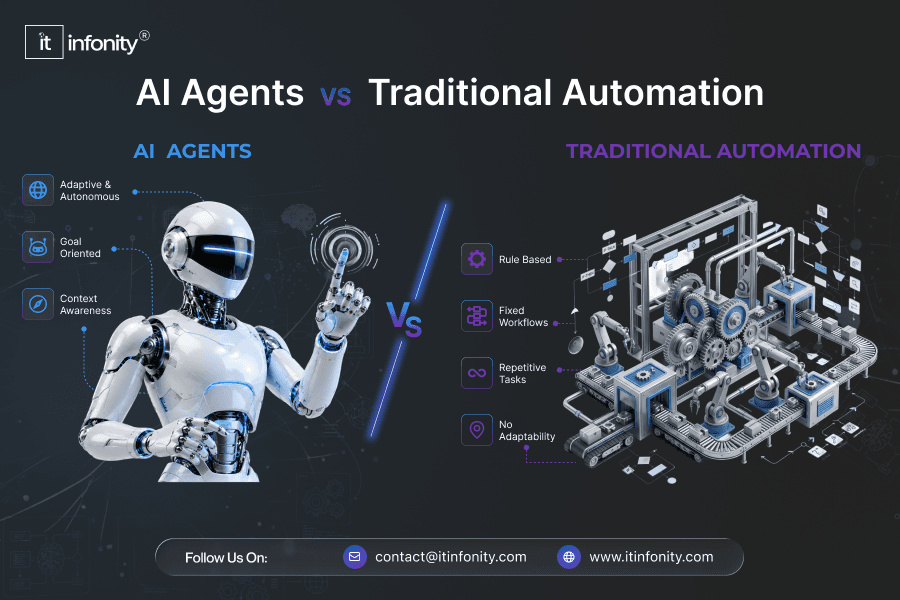
Agentic AI represents the next level of artificial intelligence technology that can plan, decide, and perform several actions to complete a certain task independently. Unlike traditional AI technology which only operates in response to input, agentic AI performs actions through analyzing data and deciding on the right actions to take.
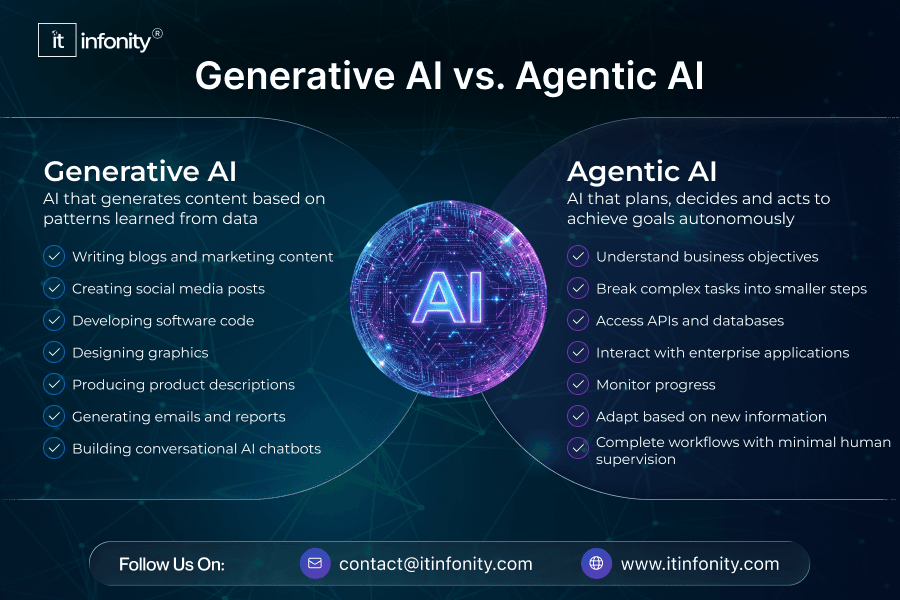
An Agentic AI system can:
- Understand business objectives
- Break complex tasks into smaller steps
- Access APIs and databases
- Interact with enterprise applications
- Monitor progress
- Adapt based on new information
- Complete workflows with minimal human supervision
For instance, an artificial intelligence-driven agent for customer service can perform such tasks as receiving a support query, analyzing customer data, prioritizing the concern, allocating the concern to the correct team, sending automatic replies, updating the CRM system, and informing relevant people all without any human intervention.
Reasoning and acting skills make an agentic AI the perfect candidate for business automation.
What is Generative AI?
AI generation is all about making something anew from what you tell it to make. It uses language models and multimodal AI models for producing text, images, videos, audio, codes, and other digital material.
Businesses use Generative AI for:
- Writing blogs and marketing content
- Creating social media posts
- Developing software code
- Designing graphics
- Producing product descriptions
- Generating emails and reports
- Building conversational AI chatbots
However, as opposed to agentic AI, generative AI normally works based on prompts rather than completing the end-to-end workflow autonomously.
The fast speed, creativity, and ability to produce high-quality content makes generative AI an important technology for marketing, engaging with customers, developing software, and producing content.
Agentic AI vs Generative AI: Comparison Table
| Feature | Agentic AI | Generative AI |
| Primary Purpose | Execute tasks and achieve goals | Generate content |
| Autonomy | High | Limited |
| Decision-Making | ✔ Yes | Limited |
| Multi-Step Planning | ✔ Yes | ✖ No |
| Workflow Automation | End-to-end automation | Content assistance |
| Human Involvement | Minimal | Frequent |
| API & Software Integration | Extensive | Limited |
| Best For | Business automation | Content creation |
| Business Impact | Operational efficiency | Creativity & productivity |
Key Differences Between Agentic AI and Generative AI
1. Purpose
While the function of Generative AI is to generate content quickly, Agentic AI is used for performing tasks that require the ability to set goals and complete them.
Generative AI uses user prompts to generate responses, while agentic AI can analyze an environment and perform actions without being constantly controlled by a human operator.
2. Decision-Making Capacity
The function of generative AI is to suggest or produce content but does not have the capacity to decide on actions to be taken.
Agentic AI analyses available information and decides on the most appropriate action to be taken.
3. Workflow Execution
Generative AI enables the execution of individual tasks like drafting emails or coding.
Agentic AI executes entire workflows. It can process customer inquiries, authenticate accounts, update information, notify customers, and close support tickets automatically.
4. Level of Automation
Generative AI enhances efficiency through employee assistance for content generation and other routine tasks.
Agentic AI provides greater automation through the replacement of routine processes with smart and purposeful processes.
5. Business Impact
Generative AI aids in working faster to create quality content.
Agentic AI revolutionizes businesses by increasing efficiency and accuracy through automation of processes.
How Agentic AI Works
Agentic AI follows a structured process to accomplish business objectives.
- Understands the objective by analyzing the user’s request or business goal.
- Creates an execution plan by breaking the objective into manageable tasks.
- Uses external programs, such as API, database, CRM systems, and other enterprise software.
- Executes actions while monitoring progress in real time.
- Improve itself through the analysis of results and decision making for the future.
The cycle above makes Agentic AI work like a smart digital assistan.
How Generative AI Works
Generative AI works through the use of highly advanced machine learning models trained on huge data sets to produce relevant outputs.
The process includes:
- Receiving a user prompt
- Understanding context
- Predicting the most relevant response
- Generating text, images, code, or other content
For example, a marketing team can ask Generative AI to create product descriptions, email campaigns, or advertising copy within seconds, significantly reducing content creation time while maintaining quality.
Real-World Examples of Agentic AI and Generative AI
Knowing about real-world applications enables companies to select the appropriate AI tool for themselves.
Customer Support
Generative AI: Creates personal email letters, sales proposals, and follow-up letters.
Agentic AI: Qualifies the lead, schedules meetings with customers, updates CRM record, assign opportunities to the sales people.
Sales & Lead Management
Generative AI: Can create personalized sales email copy, product proposal, follow up copy.
Agentic AI: Can qualify leads, schedule appointments, update CRM with customer information, assign opportunity to sales representative, and track customers’ interactions without requiring any human involvement.
Software Development
Generative AI: Helps software developers write code, understand programming concepts, generate documentation, and find bugs.
Agentic AI: Helps in managing the workflow of software development process through task assignments, project tracking, running automated tests, and managing the process of deployment.
Human Resources
Generative AI: Can create job descriptions, onboarding documents, interview questions, and employee training programs.
Agentic AI: Automatically screens resumes, shortlists candidates, schedules interviews, sends reminders, updates recruitment management system, and tracks the entire hiring process.
Finance
Generative AI: Summarizes finance and gives insights into businesses based on accounting data.
Agentic AI: Process invoices, detects unusual transactions, updates accounting systems, monitor compliance, and prepares financial reports.
Business Use Cases of Generative AI
Generative AI has proven useful for enterprises who seek to enhance productivity and creativity as well as engage customers. With the ability to produce quality content within seconds, Generative AI saves time in order for team members to concentrate on more strategic activities.
Marketing & Content Generation
Marketing departments employ Generative AI in order to develop content such as blog posts, landing pages, social media, emails, product description texts, and advertisements.
Software Development
Programmers utilize Generative AI in the creation of codes, explanation of programming concepts, bug identification, and software development cycles.
Customer Support
AI-powered chatbots use Generative AI to answer customer questions, summarize conversations, provide personalized responses, and improve self-service experiences.
Design & Creative Media
Companies utilize the power of artificial intelligence in design tools to create logo, marketing visuals, presentation, video, and other promotional media content.
Human Resources
Generative AI is used in human resource departments for writing job descriptions, onboarding material, training materials, performance review, and many more.
Business Use Cases of Agentic AI
With agentic AI, companies can automate their business processes using decision-making and task completion capabilities with minimal human interference.
Customer Support Automation
With agentic AI, companies can automatically receive customer support requests, validate customer details, classify their needs, allocate tickets, update CRM databases, and follow up with customers.
Sales Automation & CRM
Agentic AI is utilized for lead qualification, scheduling meetings, follow-up emails, customer record updates, and sales pipeline management.
Healthcare
Agentic AI is used by healthcare providers to automate scheduling of appointments, follow-ups, administration processes, managing medical records, and verifying insurance.
Finance & Banking
Agentic AI is used in finance and banking organizations to automate billing and invoice processing, expenses management, fraud detection, compliance checking, and financial reporting.
Supply Chain and Logistics
Using Agentic AI, companies can automate forecasting, inventory management, shipping, purchasing, and warehouse management.
IT Operations
Agentic AI is used to automate IT operations such as infrastructure monitoring, failure detection, incident response, cybersecurity, and deployment.
Benefits of Generative AI
Benefits of Generative AI for Businesses Include the Following.
- Increases speed of content creation and marketing campaigns.
- Increases productivity of employees through automation of monotonous activities.
- Helps software developers in code generation and documentation.
- Increases engagement of customers through personalized interaction.
- Develops marketing and branding campaigns.
- Decreases cost of operations linked to content creation.
Benefits of Agentic AI
Agentic AI brings about a revolution in the way that businesses operate through intelligent automation and decision-making.
Increased Efficiency
Through the use of automated processes and coordination of tasks, agentic AI enables individuals to concentrate on higher value processes.
Faster Decision-Making
Agentic AI takes decisions using data collected in real-time in order to make actions in a timely manne.
Reduced Operational Costs
Automation helps businesses cut costs associated with labor and improve utilization of resources.
Increased Accuracy
Since agentic AI acts according to defined business logic but still learns through feedback, its decisions are more accurate.
Better Customer Experience
Agentic AI provides automated assistance in addition to faster and personalized customer interactions that lead to increased customer satisfaction.
Business Scalability
Businesses can scale their operations easily without increasing workforce.
Future Trends of Agentic AI and Generative AI in 2026
AI technology is currently transforming from being an instrument for mere tasks to a tool for intelligent business orchestration. In the year 2026, businesses are adopting Agentic AI and Generative AI to create systems capable of producing content and carrying out processes on their own.
Some of the biggest trends shaping AI adoption include:
- AI-enabled agents able to control complete business processes.
- Use of multi-agent systems working together to solve business issues.
- Improved integration with CRM, ERP, cloud computing platforms, and enterprise applications.
- Customer experience hyper-personalized through use of AI technology.
- Use of AI to automate business process workflows.
- Emphasis on responsible AI and security.
Businesses that invest in these technologies today will be better positioned to improve operational efficiency, reduce costs, and maintain a competitive advantage in the years ahead.
Why Choose IT Infonity for AI Development?
The proper selection of technology forms just one aspect of a good AI strategy. It is equally essential to pick an experienced partner to work on developing AI technologies.
IT Infonity provides customized AI solutions that assist organizations in automating processes, making better decisions, and enabling rapid digital transformation.
Our AI development services include:
- Agentic AI Development
- Generative AI Solutions
- AI Chatbot Development
- AI Automation Services
- Custom AI Software Development
- Machine Learning Solutions
- Large Language Model (LLM) Integration
- AI Integration with CRM, ERP, and Enterprise Applications
- AI Consulting & Digital Transformation
- AI-Powered Web and Mobile Applications
Our Development Approach
For all AI projects at IT Infonity, we follow an established development approach:
- Business Discovery – Identifying your objectives, constraints, and opportunities for automation.
- AI Strategy & Solution Design – Choosing appropriate AI technologies and developing a solution architecture.
- Development & Integration –Developing custom AI solutions and integrating them with your existing infrastructure.
- Testing & Deployment –Providing for security, reliability, and efficiency before deployment.
- Continuous Optimization –Monitoring, improving performance, and optimizing AI models.
Whether you want to develop innovative AI-enabled products, automate workflows in your enterprise environment, or integrate intelligent agents into your existing software, we offer solutions that bring tangible benefits to your business.
Conclusion
Two of the most powerful forms of artificial intelligence include Agentic AI and Generative AI, each solving distinct business problems. Where Generative AI makes use of the creativity of its users in creating text, images, code, and other digital content, Agentic AI takes things further through planning, reasoning, and workflow execution without much human intervention.
Not limiting oneself to choosing either of the two AI, many firms are using both of these technologies for the creation of intelligent solutions which increase their productivity and automate their business processes while ensuring exceptional customer experience.
At IT Infonity, we assist businesses in bringing the AI concepts to reality. Be it developing AI applications or implementing AI into their processes and systems or building enterprise AI software – our experts provide you with secured and scalable AI solutions, custom made for your business objectives.